The Ontario Form 13 Financial Statement.
Form 13 is the Financial Statement (Support Claims) under Ontario's Family Law Rules. It is used where a family-law case includes a claim for support but no property claim and no claim for exclusive possession of the matrimonial home and its contents. This page explains what it asks for, part by part.
What is Ontario Form 13?
Form 13 is titled “Financial Statement (Support Claims).” It is a sworn or affirmed court form used to disclose financial information relevant to support issues in an Ontario family-law case.
Rule 13 of the Family Law Rules governs financial disclosure. Where an application, answer or motion contains a support claim, a property claim, or a claim for exclusive possession of the matrimonial home and its contents, Rule 13 generally requires financial disclosure. The rule then distinguishes between Form 13 and Form 13.1 according to the claims in the case.
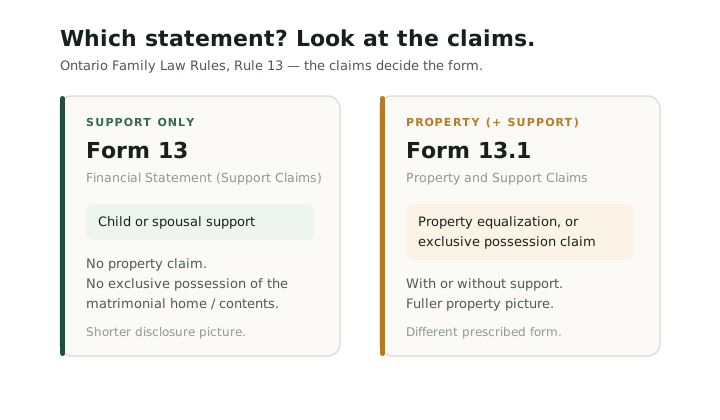
Form 13 is the prescribed financial statement for a support claim without a property claim and without a claim for exclusive possession of the matrimonial home and its contents.
This page is general legal information, not legal advice. It does not determine which form you must file, decide what claims you should make, or apply the rules to your circumstances. The claims in your court documents, the Family Law Rules and the current official form decide which form applies.
Form 13 or Form 13.1?
The difference is the type of claim, not the size of your finances. The two forms are not interchangeable.
Form 13 — Financial Statement (Support Claims)
Used under Rule 13 where there is a support claim but no property claim and no claim for exclusive possession of the matrimonial home and its contents.
Form 13.1 — Financial Statement (Property and Support Claims)
Used where there is a property claim or a claim for exclusive possession of the matrimonial home and its contents — whether or not support is also claimed. It carries more extensive property disclosure: three dated valuation columns and the net family property calculation. Read the Form 13.1 guide →
Repmyself does not decide which claims a person should make, or which financial statement is legally required in an individual case.
When is a financial statement required?
Ontario's Guide to Procedures in Family Court explains that a financial statement is usually required where a case involves child support, spousal support, or claims relating to property or debts.
Rule 13 sets out the more precise procedural requirements. Where an application, answer or motion contains a claim requiring a financial statement, the party making the claim generally serves and files the appropriate financial statement together with the document containing the claim. The responding party generally serves and files a financial statement within the time for serving and filing the responding document.
One common exception — the table amount. Where the only support claim is for the table amount of child support under the applicable Child Support Guidelines, the party making that claim is generally not required to file a financial statement, unless the case also includes a property claim or a claim for exclusive possession of the matrimonial home and its contents.
What Form 13 asks for.
Form 13 organises disclosure into five parts, asking for both current and historical financial information.
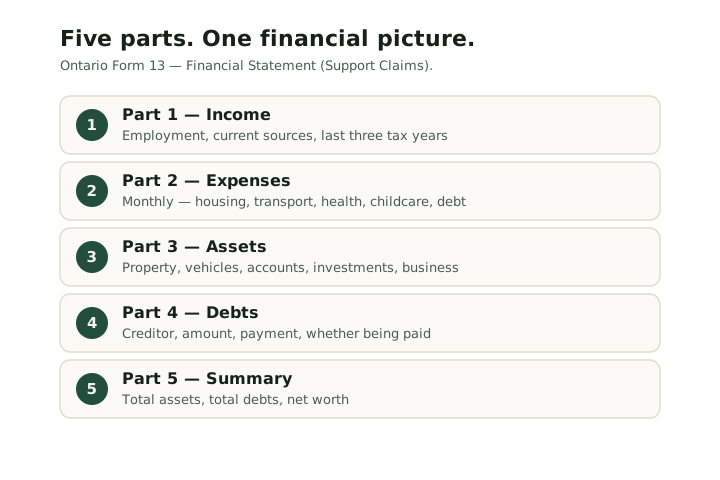
Part 1 — Income
The form asks whether you are employed, self-employed or unemployed, and requests proof of year-to-date income from all sources — a recent pay stub, pension stub, Employment Insurance or workers' compensation information, social-assistance information, or a statement of income and expenses if self-employed. It also asks for gross income from all sources for the previous year, and income information for the previous three taxation years.
- Monthlyemployment income; commissions, tips and bonuses; self-employment income; Employment Insurance; workers' compensation; social assistance; investment income; pension income; spousal support received; tax benefits and rebates; other income
- Non-cashbenefits such as employer-provided medical insurance, use of a company vehicle, or room and board
Part 2 — Expenses
Monthly expenses across automatic deductions, housing, utilities, transportation, health, household, childcare and child-related costs, personal expenses, debt payments and other expenses — with specific lines for rent or mortgage, property taxes, condominium fees, groceries, telephone and internet, vehicle costs, insurance, medication, daycare, school expenses, children's activities and support paid for other children. The form totals both monthly and yearly expenses.
Part 3 — Assets
Although Form 13 is the support-claims statement, it still asks for a summary of assets: real estate; cars, boats and other vehicles; other valuable possessions; investments; bank accounts; RRSPs, pension plans and RESPs; life insurance; interests in businesses; money owed to you; and other assets — with a value for each and a total.
Part 4 — Debts
For each debt: the creditor, the full amount owing, the monthly payment, and whether payments are currently being made. Categories include mortgages, lines of credit and other bank or finance-company loans, credit-card balances, unpaid support amounts and other debts.
Part 5 — Summary of assets and liabilities
Total assets, total debts and net worth. This does not turn Form 13 into a property-claims financial statement — it is a financial snapshot for support-related disclosure. Form 13.1 remains the prescribed form where a property claim or a claim for exclusive possession is included.
The schedules, and Form 13A.
Schedule A — Other income. For income not fully shown in the main income section: the form identifies examples including partnership income, dividends, rental income, capital gains and RRSP income.
Schedule B — Other income earners in the home. Required by the form's instructions where you have made or responded to a claim for child support involving undue hardship, or a claim for spousal support: who else lives in the home, whether a spouse or partner works and what they earn, and what another adult contributes to household expenses. On Form 13.1 this material is Part 3 of the main form rather than a schedule.
Schedule C — Special or extraordinary expenses for the child(ren). Required where you or the other party has sought a contribution towards those expenses. Note the letters differ between the forms: the equivalent schedule on Form 13.1 is Schedule B.
Form 13A — Certificate of Financial Disclosure. A separate form, listed separately by Ontario Court Services, used in connection with prescribed financial documents. Form 13 is the financial statement; Form 13A is the certificate. They are not the same thing.
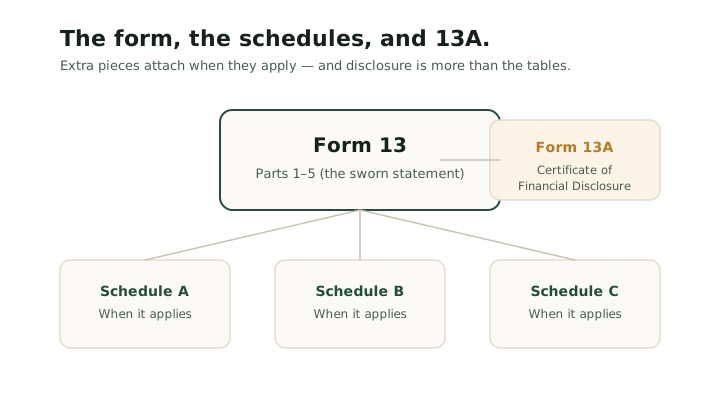
A schedule is not optional just because the main tables are done. The official form controls which schedules must be completed.
The documents that go with it.
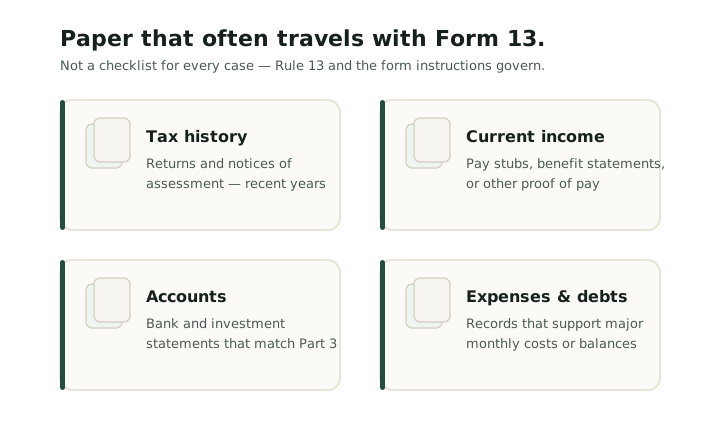
Form 13 does not operate in isolation — Rule 13 contains additional disclosure requirements, and Ontario's family-court guidance treats disclosure as both information and supporting documentation. Depending on your circumstances, that may include:
- Proof of current year-to-date income
- Notices of assessment and reassessment for the previous three taxation years
- Income-tax information required by the rules or the form
- Records relating to self-employment income, where applicable
- Records relating to Employment Insurance, workers' compensation or other benefits
- Information about pensions and investment income
- Records for bank accounts, investments and registered plans
- Mortgage, loan and credit-card information
- Information about business interests, where applicable
- Documents supporting special or extraordinary child-related expenses, where in issue
Income-tax returns are treated differently. Serving a financial document and filing it in the continuing record are not always the same thing. Except where a rule provides otherwise or the court orders otherwise, income-tax returns submitted under the financial-disclosure rules are not required to be filed in the continuing record. Check the current rule and court instructions before filing tax material — it contains highly sensitive personal information.
When Form 13 has to be updated.
Ontario's current Guide to Procedures in Family Court states that a financial statement must be updated:
- Before trial, if the last financial statement is more than 40 days old
- Before a case conference or settlement conference, if it is more than 60 days old
- Before a motion, if it is more than 30 days old
- Whenever there has been a significant change in financial circumstances, at any stage
Ontario's guidance identifies two ways to update, depending on how much has changed: a new Form 13 or Form 13.1 where the changes are significant, or Form 14A: Affidavit (General) where the changes are minor or the previous statement remains accurate. The applicable rule and current court guidance control the timing and the method.
Points worth checking.
- The right statement. Form 13 and Form 13.1 are prescribed for different claims. Compare the claims in your case against Rule 13 and the current form instructions.
- The current form. Ontario Court Services maintains the current Family Law Rules forms. An older saved copy may not be the form now prescribed.
- Monthly versus annual. Form 13 contains both. A figure entered for the wrong period distorts the totals.
- Current income and historical tax information. The form asks for both, and they serve different purposes within it.
- The applicable schedules. A, B or C may apply depending on your information and the claims in the case.
- Supporting disclosure. Filling in the boxes does not necessarily complete the disclosure obligation under Rule 13.
- Swearing or affirming. Form 13 is not finished because the tables are filled in — it carries a sworn or affirmed declaration and signing requirements, completed before a person authorised to take the oath or affirmation.
What a tool like this can and cannot do.
A guided tool can collect what you enter, organise it into the structure of the form, do the arithmetic, flag fields left blank or figures that do not reconcile, work out which schedules your answers call for, and help you identify the categories of supporting documents.
It cannot, and will not:
- decide whether you should make a child-support, spousal-support or property claim;
- determine whether Form 13 or Form 13.1 is legally required in your case;
- decide how disputed income, property or debt should be characterised;
- determine whether what you enter is true;
- choose a litigation or settlement position, or predict what a court will decide; or
- give legal advice, or act as your lawyer or representative.
Want the Form 13 tool when it's ready?
Repmyself builds guided tools for court forms — today for British Columbia. An Ontario Form 13 tool is not available yet, and we are not going to launch one until it has been tested properly against the real form. If you would use it, tell us. One email, once, when it opens — and if it doesn't go ahead, you'll never hear from us about it again.
You're on the list.
Thanks — we've got your details. You'll hear from us once, when the Ontario Form 13 tool opens. If it doesn't go ahead, you won't hear from us at all.
Questions in the meantime: info@repmyself.ca.
Questions people actually ask.
Is Form 13 only for spousal support?
No. Form 13 is the Financial Statement (Support Claims). It can relate to child-support and spousal-support claims, subject to the requirements and exceptions in Rule 13.
Do I need Form 13 if I am only asking for the table amount of child support?
Rule 13 contains an exception where the only support claim is for the table amount of child support under the applicable Child Support Guidelines. In that situation the party making the claim is generally not required to file a financial statement, unless the case also includes a property claim or a claim for exclusive possession of the matrimonial home and its contents.
Can Form 13 be used if there is also a property claim?
Rule 13 provides that where there is a property claim, or a claim for exclusive possession of the matrimonial home and its contents, the financial statement is Form 13.1 — whether or not support is also claimed.
Why does Form 13 ask about assets and debts if it is for support claims?
Form 13 collects a broader financial picture than income alone. It includes assets, debts and net worth even though it is not the financial statement prescribed for property claims.
What is the difference between Form 13 and Form 13A?
Form 13 is the Financial Statement (Support Claims). Form 13A is the Certificate of Financial Disclosure. They are separate forms, used for different purposes within the financial-disclosure process.
Can I reuse an older Form 13 already filed in my case?
Financial disclosure may need to be updated. Ontario's current procedural guidance sets age thresholds before motions, conferences and trials, and also calls for updating after a significant change in financial circumstances.
Is Form 13 the same as a budget?
No. Form 13 includes an expense section, but it also contains income, asset and debt disclosure — and it is sworn or affirmed.
Does Repmyself decide what goes in disputed categories?
No. A guided tool can organise what you enter and explain neutral form terminology. It does not decide disputed legal classification, and it does not apply the law to contested facts.
Where this comes from.
- Ontario Court Services — Family Law Rules Forms (current listing for Form 13: Financial Statement (Support Claims), Form 13A: Certificate of Financial Disclosure, and Form 13.1: Financial Statement (Property and Support Claims)) — https://ontariocourtforms.on.ca/en/family-law-rules-forms/
- Family Law Rules, O. Reg. 114/99 — Rule 13 (Financial Disclosure) — https://www.ontario.ca/laws/regulation/990114
- Ontario Ministry of the Attorney General — Guide to Procedures in Family Court: Financial Disclosure — https://www.ontario.ca/document/guide-procedures-family-court/financial-disclosure
- Ontario Ministry of the Attorney General — Guide to Procedures in Family Court: Updating Your Financial Disclosure — https://www.ontario.ca/document/guide-procedures-family-court/updating-your-financial-disclosure
- Federal Child Support Guidelines, SOR/97-175 — https://laws-lois.justice.gc.ca/eng/regulations/SOR-97-175/
This page provides general legal and procedural information for Ontario. It does not determine whether a financial statement is required in any particular case, decide which form applies, decide what claims a person should make, or provide legal advice. Rules and forms are amended; always confirm the current requirements against the Family Law Rules and the current official form before filing. Last source review: September 2026.
Related reading.
Ontario Form 13.1 — Financial Statement (Property and Support Claims) — the companion form, for cases that include a property claim.
What financial disclosure is, and why it comes first — the jurisdiction-neutral guide.
Ontario financial statements — the hub for both forms.
Guided tools are live for British Columbia: BC financial statements →