What can and can't go in an affidavit.
An affidavit is your evidence, written down and sworn. It is not a letter to the judge, and it is not your argument. That single distinction decides most of what belongs in one — and almost everything that gets ignored. This page covers the principles, which are common across Canadian courts. The rule numbers, the forms and the page limits are provincial, and are covered separately.
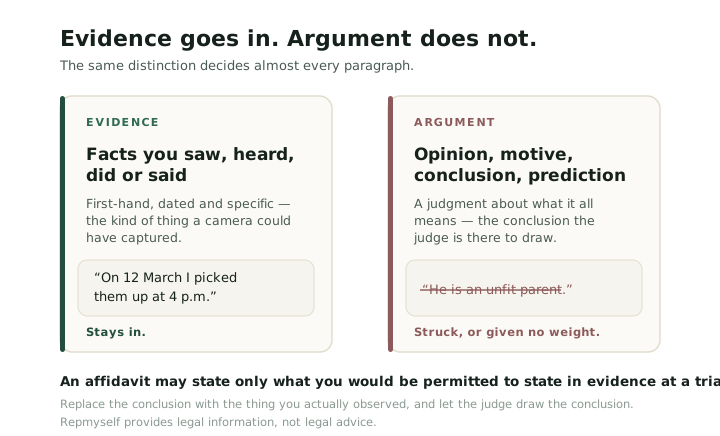
An affidavit may contain only what you would be allowed to say from the witness box at a trial. In practice that means facts you personally saw, heard, did or said, that are relevant to the question actually before the court.
Your opinion of the other party, your conclusions about their motives, your predictions, your feelings about what happened, and the reasons you should win are not evidence. They are argument — and argument belongs in what you say to the judge, not in a sworn document.
On this page
- The one rule everything else follows from
- What actually goes in
- The lines that get struck — and what to write instead
- When you can write what someone else told you
- Exhibits — and why attaching a document is not enough
- What happens when an affidavit breaks the rules
- What changes from province to province
1The one rule everything else follows from.
There is no separate, lower standard for evidence written down. An affidavit stands in place of you giving oral testimony, so it is held to the same limits. Court rules across Canada express this in almost identical language: an affidavit must state only what the person swearing it would be permitted to state in evidence at a trial.
Everything below is an application of that one sentence. A witness in the box may describe what they saw, heard, did and said. A witness may not tell the judge what the other party was thinking, what a document means, what is fair, what should happen next, or what the law is. Those are matters for the judge to decide, after hearing argument — and a sworn statement is not the place for them.
Even a perfectly admissible fact does not belong in the affidavit if it has nothing to do with the question in front of the court. Include only facts that can help prove or disprove something actually in issue. A long affidavit about the whole history of a relationship, filed on an application about one narrow point, mostly answers a question nobody asked — and it costs you the reader's attention for the parts that matter.
2What actually goes in.
The shape is conventional across Canadian courts, even where the wording of the rule differs.
The frame
- Written in the first person — "I", not "the deponent"
- Your name, address and occupation
- Whether you are a party, or connected to one
- Divided into paragraphs numbered consecutively
- Sworn or affirmed before someone authorised to take oaths, who signs a statement saying so
The substance
- Facts within your own knowledge — what you saw, heard, did or said
- Dated and specific, in chronological order
- One fact per paragraph, in short sentences
- Names, not pronouns, once more than two people are involved
- Documents you rely on, referred to in the body and attached as exhibits
- Your own words. An affidavit that reads as though a lawyer wrote it makes it harder, not easier, for a court to assess. Write it the way you would say it.
- One fact per paragraph. The other party has to be able to admit, deny or answer each paragraph on its own.
- Dates, not impressions. "On 12 March 2026" carries weight; "around that time" invites a fight about whether it happened at all.
- If you did not personally perceive it, either leave it out or identify where it came from — see hearsay below.
3The lines that get struck — and what to write instead.
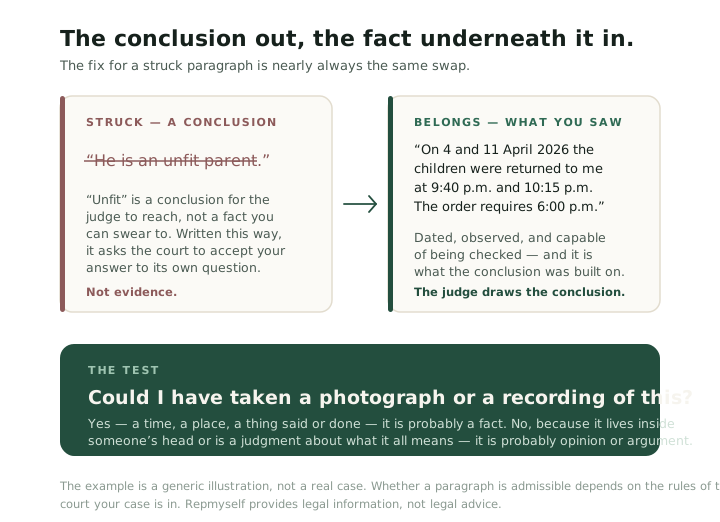
Almost every problem paragraph is one of a small number of recurring moves: giving an opinion, guessing at someone's motive, arguing, predicting, or hedging instead of stating a fact. The fix is nearly always the same — replace the conclusion with the thing you actually observed that led you to it, and let the judge draw the conclusion.
| Instead of writing | Write the underlying fact | Why |
|---|---|---|
| "He is an unfit parent." | "On 4 and 11 April 2026 the children were returned to me at 9:40 p.m. and 10:15 p.m. The order requires 6:00 p.m." | "Unfit" is a conclusion for the judge. The late returns are facts you observed, and they are what the conclusion was built on. |
| "She is deliberately hiding income." | "Her 2025 tax return shows $41,000. The 14 June 2026 bank statement attached as Exhibit C shows deposits of $9,200 that month." | Intent is not something you can perceive. Set out the figures and the documents; the inference is the court's to draw. |
| "He only wants more parenting time to reduce his support." | "On 2 May 2026 he texted me: 'if I have them half time I pay you nothing.' The message is attached as Exhibit D." | Another person's motive is not within your knowledge. What they actually wrote or said is. |
| "I was shocked and disgusted by her behaviour." | "She arrived at my door at 11:20 p.m. on 3 June 2026 and knocked for about ten minutes." | Your emotional reaction is not a fact in issue. The event is. |
| "He will never bring them back on time." | "Of the twelve exchanges between January and June 2026, he was more than an hour late on seven: 12 and 26 January, 9 February, 23 March, 6 and 20 April, and 4 May 2026." | A prediction about the future is not evidence. Past conduct is, and it is what lets a court draw its own conclusion about the future. |
| "My daughter is anxious about going to his house." | "On the last four exchanges my daughter cried in the car and asked to stay home." Or, if the rule on hearsay is met, what she told you and when. | You cannot swear to another person's internal state. You can swear to what you observed, or to what you were told, with the source identified. |
| "It is clearly unfair that I have to pay this." | Nothing — delete it. | Fairness is the question the judge is deciding. Arguing it in a sworn document does not make the argument evidence. |
| "The case law says a parent in my position gets primary residence." | Nothing — delete it. | The law is not a fact you can swear to. Legal submissions belong in what you say to the court, not in your affidavit. |
| "To the best of my knowledge he was not working." "I understood that he had moved." "I believe she cancelled the policy." |
Either state it as a fact you know — "He told me on 6 May 2026 that he had stopped working" — or identify where the information came from and say you believe it to be true. | These hedges usually signal that the statement is not within your own knowledge. If it is not, the hearsay rule applies and the source has to be named. |
| "Everyone knows he has a drinking problem." "I have been told by several people that…" |
"On 9 July 2026 [name] told me that…, and I believe that information to be true." | An unnamed source cannot be assessed or answered. Where information and belief is allowed at all, the source has to be given. |
| "He constantly harasses me with an endless stream of abusive messages." | "Between 1 and 14 August 2026 he sent me 63 text messages. They are attached as Exhibit F." | Adjectives and intensifiers are argument in disguise. The count and the exhibit are stronger and cannot be argued with. |
| "I have read his affidavit and deny everything in it except where expressly admitted." | Answer the specific paragraphs: "Paragraph 14 is not correct. I did not attend the school on 8 May 2026; I was at work, and my timesheet is Exhibit B." | A blanket denial is a pleading technique, not evidence. It tells the court nothing about which facts are actually in dispute. |
Read each paragraph and ask: could I have taken a photograph or a recording of this? If the answer is yes — a time, a place, a thing said, a thing done — it is probably a fact. If the answer is no, because it lives inside someone's head or is a judgment about what it all means, it is probably opinion or argument, and it does not belong in the affidavit.
4When you can write what someone else told you.
Repeating what another person said, in order to prove that what they said was true, is hearsay — and hearsay is presumptively inadmissible. Court rules across Canada commonly make an exception for affidavits used on interim applications: you may state something on information and belief if you identify the source of the information and say that you believe it.
Two things about that exception are worth knowing before you rely on it.
- It is narrower than people assume. In several jurisdictions it is available only where the application does not seek a final order. On a final order, or at trial, the ordinary rule applies and the person with first-hand knowledge generally has to give their own evidence.
- A general opening paragraph is not enough. Affidavits often open with a sentence like "I have personal knowledge of the facts stated here, except where stated to be on information and belief, in which case I believe them to be true." On its own that preamble does not make any particular paragraph admissible. The requirement is to identify the source of the specific statement, in the paragraph where you make it.
Name the person, give the date, say what they told you, and state that you believe it. For example: "On 9 July 2026, Ms. Novak, the children's teacher, told me that Ellie had missed nine days of school that term, and I believe that information to be true." Where you can, the better course is to have that person swear their own affidavit instead — a first-hand account is always stronger than a second-hand one, and it can be tested.
5Exhibits — and why attaching a document is not enough.
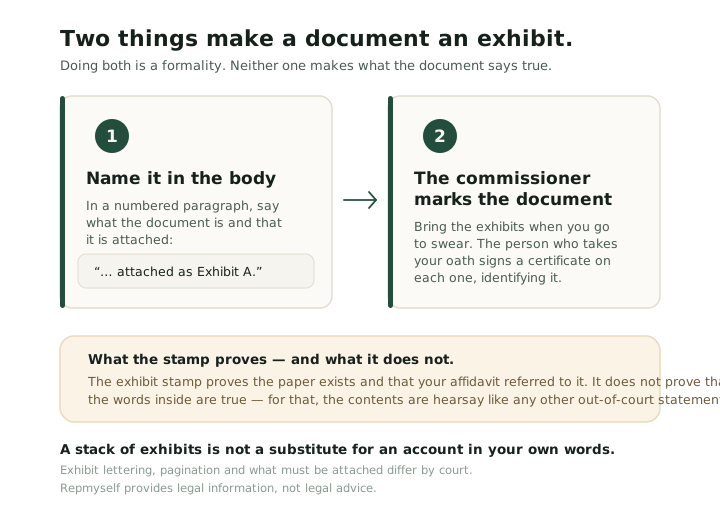
There are two separate questions about any document you attach, and getting the first one right does not answer the second.
The formalities
The person before whom the affidavit is sworn identifies each exhibit by signing a certificate on it, usually worded along the lines of "This is Exhibit ___ referred to in the affidavit of ___ sworn before me on ___."
Bring the exhibits with you when you swear the affidavit — they are marked at the same time, by the same person. Rules on how exhibits are lettered, paginated, and whether long documents must be attached or merely made available differ by court.
Whether the contents are admissible
Marking a document as an exhibit does not convert what is written inside it into evidence of its truth. A letter attached as Exhibit A proves the letter exists and that you received it. It does not, without more, prove that the statements in the letter are true — for that purpose the contents are hearsay like any other out-of-court statement.
The practical consequence: a stack of exhibits is not a substitute for an account. If a document matters, say in the body what it is, how you came to have it, and what you personally know about it.
- Introduce every exhibit in the body. A document attached at the back that no paragraph mentions is doing nothing.
- Letter them in the order they are first referred to — A, B, C — following the order of the paragraphs.
- Do not summarise a document instead of attaching it. An exhibit speaks for itself; a paragraph describing what you think it shows is your opinion of it.
- Attach the page that matters, not the whole file. Some courts cap the total length of an affidavit including its exhibits.
6What happens when an affidavit breaks the rules.
The usual consequence is quieter, and worse, than most people expect: nothing visible happens, and the material simply does not count. Because an affidavit is confined to what could be given in evidence at a trial, anything outside that limit is not evidence the court can act on — whether or not the other party objects, and whether or not any formal ruling is made. Courts may strike the offending passages, disregard them, or give the affidavit as a whole no weight, and in some cases costs follow.
There is a practical dimension too. Every paragraph of argument is a paragraph the other party has to read and answer, and a paragraph the judge has to work past to find the facts. A shorter affidavit made entirely of dated, sourced, relevant facts is not a weaker document than a long one — it is a considerably stronger one.
Courts routinely take steps to assist people without lawyers, and court staff can help you understand what a form requires. But the rules of evidence are the same for everyone. An affidavit that is mostly opinion and argument will be given little or no weight regardless of who wrote it — which is exactly why the effort is better spent on the facts than on the case for why you should win.
7What changes from province to province.
The principles above hold across Canadian courts. The mechanics do not. Before you swear anything, check the rules of the specific court your case is in for:
- Whether a prescribed form must be used — some courts require their own affidavit form; others accept a conventional format that carries the required content.
- Page limits — including whether exhibits count toward the limit, and what is excluded.
- When information and belief is available, and exactly what has to be stated to rely on it.
- Exhibit handling — lettering, pagination, and whether long documents are attached or made available.
- Who may take the oath, what the jurat must say, and whether swearing by video conference is permitted and how it must be recorded.
- Restrictions on content — several courts now direct what may not be attached at all, such as intimate images.
British Columbia
Worked through in full — the Supreme Court and Provincial Court rules, the forms each court uses, the two courts' different hearsay tests, exhibit handling, and the 25-page limit that applies in the Provincial Court. Affidavits in BC family court →
In BC you can also put your own numbered paragraphs into the shape the court expects and get back a document to review, swear and file. Both builders lay out what you write — neither drafts your evidence, and neither decides what belongs in it. Start with the court your case is actually in; the two courts use different documents.
BC Supreme Court — Rule 10-4 does not require a prescribed form for a general affidavit, so the builder collects what the rule itself requires: your name, address and occupation, the affidavit number and registry, and the video-conference statement where it applies.
Build a Supreme Court affidavit →BC Provincial Court — Rule 171 (1) requires the court's own form, so the builder puts your paragraphs onto Form 45 itself.
Build a Provincial Court Form 45 affidavit →Other provinces are being added. Each is worked through against that province's own rules rather than generalised from BC — so a province appears here only once its rules have been checked.
Questions people actually ask.
What can go in an affidavit?
Only what you could say from the witness box at a trial. An affidavit stands in place of oral testimony, so it is held to the same limits: facts you personally saw, heard, did or said, that are relevant to the question actually before the court. Your opinion, your conclusions, your predictions and your argument are not evidence.
Why does my opinion not belong in an affidavit?
Because opinion evidence is generally inadmissible unless it comes from a properly qualified expert. A witness gives the facts they perceived; drawing conclusions and inferences from those facts is the judge's job, not the witness's. Writing “he is an unfit parent” asks the court to accept your conclusion. Setting out what you saw him do, with dates, gives the court the material to reach its own.
Can I write what someone else told me?
Sometimes. Repeating an out-of-court statement to prove that what was said is true is hearsay, which is presumptively inadmissible. Court rules across Canada commonly allow statements on information and belief in affidavits used on interim applications, provided the source of the information is identified and the deponent states their belief in it. When it is available and what it requires varies by province and by the type of application, so check the rule that applies to your court.
Does attaching a document as an exhibit make it evidence?
Not by itself. Marking a document as an exhibit satisfies a formality; it is a separate question whether the contents are admissible for the purpose you are using them for. A letter attached as an exhibit proves the letter exists and that you received it. It does not, without more, prove that the statements inside it are true — for that purpose the contents are hearsay like any other out-of-court statement.
What happens if my affidavit contains things it should not?
Usually nothing visible happens and the material simply does not count. Courts may strike the offending passages, disregard them, or give the affidavit no weight, and in some cases costs follow. Because the consequence is often silent, an affidavit full of opinion and argument can feel forceful to write and do nothing at all for the person who filed it.
Are the rules the same if I do not have a lawyer?
The rules of evidence are the same for everyone. Courts routinely take steps to assist people without lawyers, and court staff can help you understand what a form requires, but a self-represented litigant is not held to a lower evidentiary standard. That is the practical reason to spend the effort on facts rather than on the case for why you should win.
Do affidavit rules differ across Canada?
The principles on this page — evidence not argument, facts within personal knowledge, no opinion, hearsay only with the source identified — are common across Canadian courts. The details differ: the rule numbers, whether a prescribed form must be used, page limits, who may take the oath, and exactly when information and belief is allowed. Check the rules of the specific court your case is in.