British Columbia family court forms & Provincial Court process
How a family case starts and moves through the BC Provincial Court, and the forms prescribed by the Provincial Court Family Rules (B.C. Reg. 120/2020) at each step. Provincial Court forms carry a plain number — Form 1, Form 3, Form 4, Form 6. Supreme Court family forms carry an "F" prefix and are a different set: Supreme Court Form F4 is a Response to Family Claim, not a financial statement. The Supreme Court sequence is a separate page: How a Supreme Court family case starts →
How a BC Provincial Court family case starts
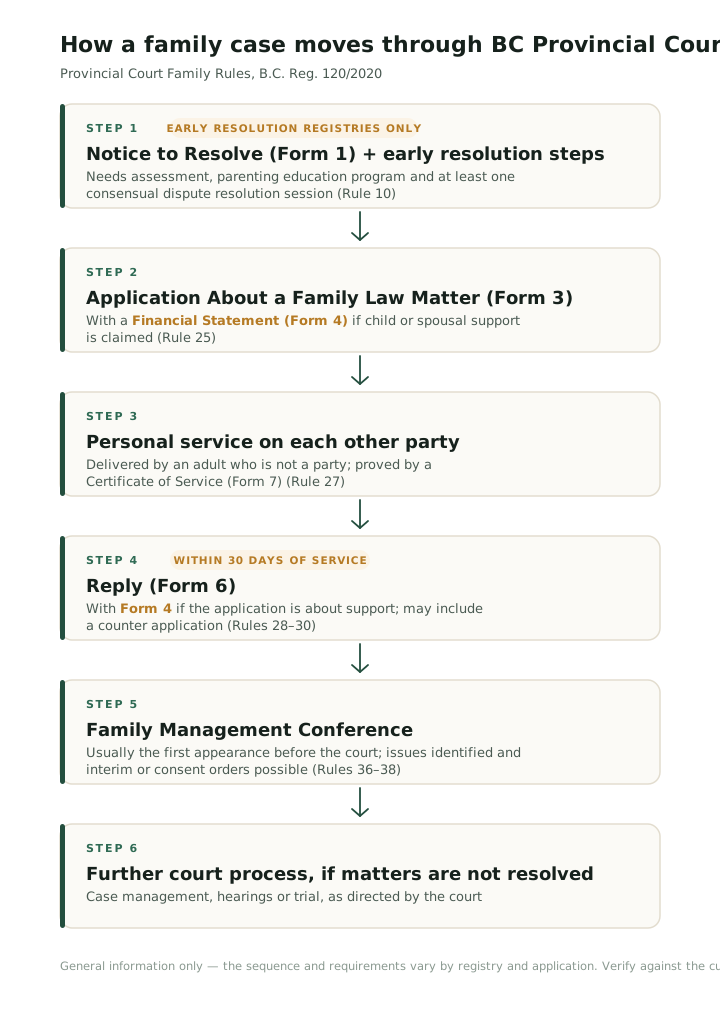
In brief below — the full step-by-step sequence, with each stage tied to its rule, is at How a Provincial Court family case starts →
There is no single starting point. Which document opens a Provincial Court family case depends on the registry the case is filed in. In an early resolution registry, a party must complete a set of early resolution requirements — beginning with a Notice to Resolve a Family Law Matter (Form 1) — before an application can be filed. In every other registry, an Application About a Family Law Matter (Form 3) starts the case.
Early resolution registry vs regular registry
As of May 1, 2026, 46 Provincial Court registries are early resolution registries, listed in Appendix 1 to the rules. The registry where the case is filed determines which track applies, so the list is the first thing to check.
Rule 10 sets out what must happen first in an early resolution registry: "Before filing an application about a family law matter under Part 3, a party seeking resolution of a family law matter in an early resolution registry must, unless otherwise provided in these rules, (a) file a notice to resolve in Form 1, (b) provide a copy of the notice to resolve to each other party, (c) participate in a needs assessment under rule 16, (d) complete a parenting education program under rule 17, and (e) participate in at least one consensual dispute resolution session under rule 18."
Provincial Court Family Rules, Rule 10; Appendix 1; B.C. Reg. 17/2026, effective May 1, 2026.
In a registry that is not an early resolution registry, those steps do not apply and the case begins with the application itself.
Form 1 — Notice to Resolve a Family Law Matter
Form 1 (PFA710) is the document that opens the early resolution track. Filing it and providing a copy to each other party are the first two of the five requirements in Rule 10. It is followed by a needs assessment with a family justice counsellor (Rule 16), a parenting education program where it applies (Rule 17), and at least one consensual dispute resolution session (Rule 18).
Form 1 is not an application. It does not ask the court to make an order — it starts the resolution process that has to be worked through before an application about a family law matter can be filed in that registry.
Form 3 — Application About a Family Law Matter
Form 3 (PFA712) is the application that asks the Provincial Court to make an order about a family law matter — parenting arrangements, contact, guardianship, child support or spousal support. Rule 24 governs applying for orders about family law matters. Where child support or spousal support is in issue, a Financial Statement (Form 4) must be filed with the application under Rule 25(1)(b) and (c).
The Form 3 guide — what it covers, section by section →
Serving the application
Filing an application does not by itself put the other party on notice. Rule 27 requires personal service: an adult who is not a party must leave with the person being served a copy of the application, the registry's instructions about how to file a reply and obtain Form 6, and any additional documents filed under Rules 25 and 26 — including any Form 4. The person who serves the documents completes a Certificate of Service (Form 7).
Provincial Court Family Rules, Rule 27; Certificate of Service, Form 7.
Form 6 — Reply
Form 6 (PFA715) is how a party who has been served responds — agreeing, disagreeing, or making a counter application. Rule 28 governs the reply and the time to file it, which is ordinarily 30 days after service. As with the application, a Financial Statement (Form 4) travels with the reply where support is in issue.
Not filing a reply does not necessarily end a party's involvement: Rule 32 preserves a discretion to direct that a party who has not filed a reply receive notice of and attend a family management conference or another conference or hearing.
The Form 6 guide — replying, counter applications and timing →
When the Form 4 Financial Statement enters the process
A Financial Statement (Form 4, PFA713) does not start a case. It accompanies an application or a reply under Rule 25(1)(b) and (c) where child support or spousal support is in issue. That means its place in the sequence depends on the track: on the standard track it arrives with the application or the reply, and on the early resolution track it arrives later, once the Rule 10 steps have been worked through and an application is filed.
Form 4 is the form the rest of this site is built around — its parts, the documents it draws on, and how to prepare each figure.
The family management conference
A family management conference is usually the first appearance before the court on a family law matter. The rules describe it as an informal, time-limited process in which a judge or family justice manager helps the parties identify the issues, explores options for resolution, and may make case management, interim and consent orders. Scheduling depends on whether a reply has been filed.
Provincial Court Family Rules, Rules 36 to 38.
Purpose, scheduling, who must attend, what the conference may consider and what orders can come out of it — Part 4, Rules 35 to 57: What happens at a Family Management Conference →
If matters are not resolved at that stage, the case continues through the further steps set out in the rules.
BC Provincial Court family forms index
The detailed guides on this site, form by form.
Application About a Family Law Matter (Form 3)
The form that starts most Provincial Court family cases — what it covers, the early resolution steps, when Form 4 must be filed with it, and service. Quoted from the rules.
Read → Provincial CourtReply to an Application (Form 6)
Responding within 30 days — agreeing, disagreeing, counter applications, and when Form 4 travels with the reply. Quoted from the rules.
Read → Provincial Court · Financial statementFinancial Statement (Form 4)
Required with an application or a reply where support is in issue — Rule 25(1)(b) and (c). Its parts, the documents it draws on, and how to prepare.
Read → Both courtsSupporting documents
What a BC financial statement calls for in each court, and where the two lists differ.
Read →Official resources
- Provincial Court Family Rules, B.C. Reg. 120/2020 — Rules 10, 16, 17, 18 (early resolution requirements); Rule 24 (applying for orders); Rule 25 (financial statement); Rule 27 (service); Rule 28 (reply); Rule 32 (attendance where no reply); Rules 36 to 38 (family management conference); Appendix 1
- B.C. Reg. 17/2026, effective May 1, 2026 — early resolution registries
- Provincial Court family forms — Form 1 (PFA710), Form 3 (PFA712), Form 4 (PFA713), Form 6 (PFA715), Form 7 Certificate of Service
The official forms and the current rules control. These guides describe what they ask for; they do not replace them.