What documents do you need for financial disclosure in BC family law?
Quick answer. A financial statement is only part of what gets filed. The rules also call for supporting documents — the records behind the numbers on the form.
The two BC courts take their document lists from different places, and the lists are not identical. In the Supreme Court, Rule 5-1(1) of the Supreme Court Family Rules defines "applicable income documents" itself. In the Provincial Court, Rule 25(1)(b) points instead to the child support guidelines and to what Form 4 itself describes.
Which financial statement applies to you
Form 4 — Provincial Court of British Columbia
Form 4 (PFA713) is the prescribed Financial Statement under the Provincial Court Family Rules (B.C. Reg. 120/2020). Rule 25(1) requires it to be filed with an application about a family law matter: under paragraph (b) for an order about child support, where the party is required under the child support guidelines to provide income information, and under paragraph (c) for an order about spousal support. Read the Form 4 guide →
Form F8 — Supreme Court of British Columbia
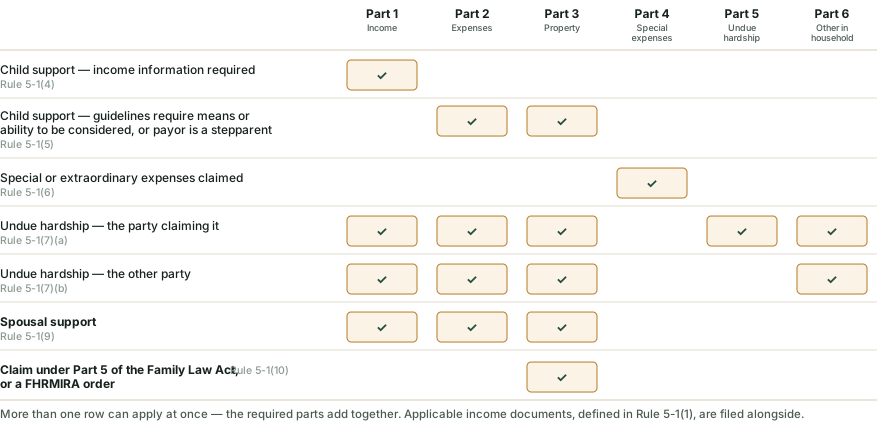
Form F8 is the Financial Statement under the Supreme Court Family Rules (B.C. Reg. 169/2009). It is not always completed in full. Rule 5-1 ties the parts to what is claimed, and more than one situation can apply at once — in which case the required parts add together. Read the Form F8 guide →
A note on form numbering
Supreme Court family forms carry an "F" prefix; Provincial Court forms do not. The two sets overlap confusingly. Supreme Court Form F4 is a Response to Family Claim, and Provincial Court Form 8 is a Reply to a Counter Application. Neither is a financial statement. If you have been told to file "Form 4", the court your case is in determines which document that is.
1. Income tax records
The starting point in both courts — Rule 5-1(1)(a) and (b) in the Supreme Court, and in the Provincial Court through the child support guidelines where child support is in issue.
- Every personal income tax return filed, for each of the three most recent taxation years;
- Every notice of assessment and reassessment issued for those same three years.
CRA My Account holds returns and notices of assessment for several years back, and the CRA will supply copies that are no longer on hand.
2. Current income records
Tax returns show last year. The rules also call for this year.
- The most recent statement of earnings showing total earnings paid in the year to date, including overtime; or
- Where the employer does not provide one, a letter from the employer setting out that information, including the rate of annual salary or remuneration.
3. If you are self-employed
For the three most recent taxation years:
- The financial statements of the business or professional practice, other than a partnership; and
- A statement showing a breakdown of all salaries, wages, management fees or other payments or benefits paid to, or on behalf of, persons or corporations with whom you do not deal at arm's length.
4. If you are a partner in a partnership
- Confirmation of your income from, draw from, and capital in the partnership, for its three most recent taxation years.
5. If you control a corporation
For the corporation's three most recent taxation years:
- The financial statements of the corporation and its subsidiaries; and
- A statement showing a breakdown of all salaries, wages, management fees or other payments or benefits paid to, or on behalf of, persons or corporations with whom the corporation, and every related corporation, does not deal at arm's length.
6. If you are a beneficiary under a trust
- A copy of the trust settlement agreement; and
- Copies of the trust's three most recent financial statements.
7. Benefits and other income sources
This is one of the places the two courts differ, and the Supreme Court asks for more.
Supreme Court
Rule 5-1(1) treats these as separate requirements: the three most recent employment insurance benefit statements where EI is received (paragraph (c)); the three most recent workers' compensation benefit statements where those are received (paragraph (d)); and current documentary evidence of income assistance where it is received (paragraph (e)). "Income assistance" there includes disability assistance under the Employment and Assistance for Persons with Disabilities Act.
Provincial Court
Through the child support guidelines, the most recent statement of income from a source such as employment insurance, social assistance, a pension, workers' compensation or disability payments — or, where there is no such statement, a letter from the appropriate authority setting out the total received during the current year.
8. Property, accounts and debts
Required where the form asks you to list assets and debts. In the Supreme Court, the most recent assessment notice from the assessment authority for each real property is itself an applicable income document under Rule 5-1(1)(k) — and where Part 3 is being served, the assessment notice goes with it under Rule 5-1(12).
Beyond that, these come from what the forms request rather than from a prescribed list, so gather what applies to the parts you are completing:
- property assessment notice, any appraisal, and a current mortgage statement showing the balance owing;
- recent statements for bank accounts, investment accounts, RRSPs, TFSAs and RESPs;
- the most recent pension plan statement;
- registration and any valuation for vehicles and other significant property; and
- recent statements for credit cards, lines of credit and loans, and any tax owing.
9. Expenses
Where the form asks for a monthly expense breakdown, the underlying records are bank and credit card statements covering the period. Pulling three to twelve months of statements makes that section considerably faster to complete.
Before you start: a gathering checklist
Use the column for your court. The two lists overlap heavily, but not completely, and they come from different places — neither is a safe substitute for the other.
Supreme Court — Form F8
Rule 5-1(1) of the Supreme Court Family Rules sets out a list it calls your "applicable income documents". That list is below. The letter in brackets after each item — (a), (b), (c) and so on — is where that item appears in the rule, so you can look it up.
- Every personal income tax return filed, three most recent taxation years — (a)
- Every notice of assessment and reassessment, same three years — (b)
- Receiving employment insurance: the three most recent benefit statements — (c)
- Receiving workers' compensation: the three most recent benefit statements — (d)
- Receiving income assistance: current documentary evidence — (e)
- An employee: most recent statement of earnings showing year-to-date total including overtime, or an employer letter giving that plus the rate of annual salary or remuneration — (f)
- Self-employed: three years of financial statements, plus the non-arm's-length payments breakdown — (g)
- A partner: income from, draw from, and capital in the partnership, three most recent taxation years — (h)
- Controlling a corporation: three years of financial statements for it and its subsidiaries, plus the non-arm's-length payments breakdown — (i)
- A trust beneficiary: the trust settlement agreement and the trust's three most recent financial statements — (j)
- Owning or holding an interest in real property: the most recent assessment notice for each property — (k)
- Every page of these documents numbered sequentially before they go to court — Rule 5-1(3)
Provincial Court — Form 4
Where child support is in issue, Rule 25(1)(b) of the Provincial Court Family Rules calls for the documents the child support guidelines require. Those are listed below. The letter in brackets after each item — (a), (b), (c) and so on — is where that item appears in section 21(1) of the guidelines.
- A copy of any existing order or written agreement the application is about — Rule 25(1)(a)
- Every personal income tax return filed, three most recent taxation years — (a)
- Every notice of assessment and reassessment, same three years — (b)
- An employee: most recent statement of earnings showing year-to-date total including overtime, or an employer letter giving that plus the rate of annual salary or remuneration — (c)
- Self-employed: three years of financial statements, plus the non-arm's-length payments breakdown — (d)
- A partner: income from, draw from, and capital in the partnership, three most recent taxation years — (e)
- Controlling a corporation: three years of financial statements for it and its subsidiaries, plus the non-arm's-length payments breakdown — (f)
- A trust beneficiary: the trust settlement agreement and the trust's three most recent financial statements — (g)
- Receiving employment insurance, social assistance, a pension, workers' compensation, disability payments or income from any other source: the most recent statement of income showing the total from that source during the current year, or a letter from the appropriate authority — (h)
Where spousal support alone is in issue in the Provincial Court, Rule 25(1)(c) requires the Form 4 without expressly importing the list above. What Form 4 itself asks for is the guide.
Where the two lists genuinely differ
| Supreme Court — Form F8 | Provincial Court — Form 4 | |
|---|---|---|
| EI benefits | Three most recent statements — 5-1(1)(c) | Most recent statement — s. 21(1)(h) |
| Workers' compensation | Three most recent statements — 5-1(1)(d) | Most recent statement — s. 21(1)(h) |
| Income assistance | Current documentary evidence, as its own requirement — 5-1(1)(e) | Within the general "other source" paragraph — s. 21(1)(h) |
| Real property | Most recent assessment notice for each property, as a required income document — 5-1(1)(k) | Not part of the guidelines list; the form's property section is the guide |
| Pension, disability, other sources | Not separately listed in the Rule 5-1(1) definition | Expressly covered by the "any other source" paragraph — s. 21(1)(h) |
| Existing order or agreement | Not part of the Rule 5-1(1) definition | Required — Rule 25(1)(a) |
| Page numbering | Every page numbered sequentially — 5-1(3) | Not stated in Rule 25 |
Gathering for the Supreme Court, pulling three EI or workers' compensation statements rather than one, and the assessment notice for every property, avoids doing it twice.
Where this fits in your case
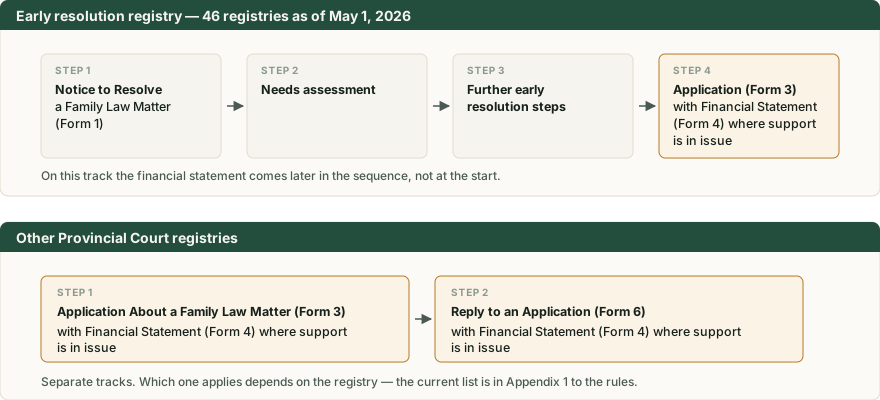
A financial statement is normally filed alongside something else, and in the Provincial Court what comes first depends on which registry the case is in.
Provincial Court — early resolution registries
As of May 1, 2026, 46 Provincial Court registries are early resolution registries under Appendix 1 to the Provincial Court Family Rules. In those registries the process ordinarily starts with a Notice to Resolve a Family Law Matter (Form 1, PFA710) and a needs assessment, and other early resolution steps apply, before an application about a family law matter is filed. The financial statement arrives later in that sequence than it does on the standard track.
The 46 cover most of the Lower Mainland, Vancouver Island and the southern interior — Surrey, Richmond, New Westminster, North Vancouver, Port Coquitlam, Abbotsford, Chilliwack, Victoria, Nanaimo, Kelowna, Kamloops and Vancouver (Robson Square) among them. They are not all of BC's registries; much of the north is not on this track. The current list is in Appendix 1 to the rules.
Provincial Court — other registries
A Financial Statement (Form 4) accompanies an Application About a Family Law Matter (Form 3), or a Reply (Form 6), where support is in issue. The sequence, including the early resolution track, is at How a Provincial Court family case starts.
Supreme Court
A Form F8 is required where child support, spousal support, or a claim under Part 5 of the Family Law Act is in issue, in the parts described above. A party who is obliged to file must do so, and serve, within 30 days after service of the document in which the claim is made where the party resides in Canada or the United States, or 60 days where the party resides elsewhere — Rule 5-1(11). That sequence is at How a Supreme Court family case starts.
Official sources
- Provincial Court Family Rules, B.C. Reg. 120/2020 — Rules 9, 10, 16, 25; Appendix 1
- B.C. Reg. 17/2026, effective May 1, 2026 — early resolution registries
- Supreme Court Family Rules, B.C. Reg. 169/2009 — Rule 5-1
- Federal Child Support Guidelines, SOR/97-175 — section 21
- Provincial Court family forms — Form 1 (PFA710), Form 3 (PFA712), Form 4 (PFA713), Form 6 (PFA715)
The official forms and the current rules control. This page describes what they ask for; it does not replace them.
Once you know which financial statement your case needs
Repmyself organises and formats the information you enter and produces your financial statement. It does not decide what to disclose, review your materials, or provide legal advice.