The BC Supreme Court Form F8 Financial Statement.
Form F8 is the Financial Statement under the BC Supreme Court Family Rules — a sworn affidavit used when your family case is in Supreme Court, including divorce and dividing property and debt. Repmyself.ca walks you through it in plain questions and produces the completed form.
Where you stand
What is Form F8?
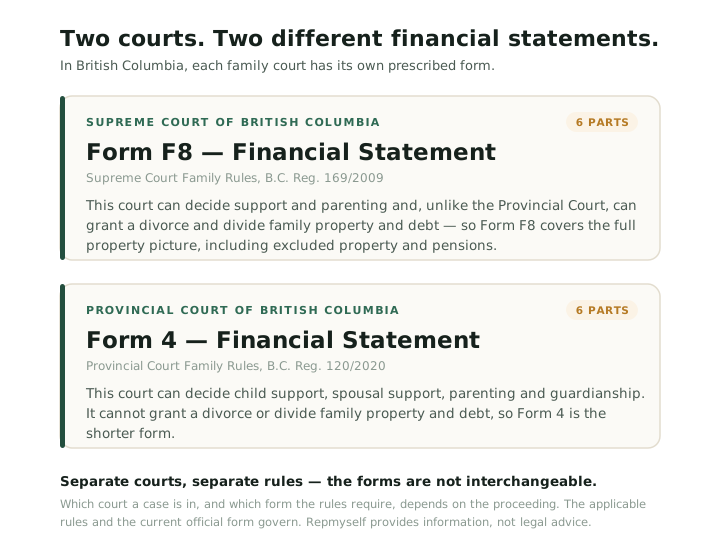
Form F8 is the prescribed Supreme Court Financial Statement, connected primarily to Rule 5-1 of the Supreme Court Family Rules (financial disclosure) and referenced in Rule 7-1 (the judicial case conference rule). It is an affidavit: the person completing it swears or affirms that the information is true and complete to the best of their knowledge. The form opens with court-file information and contains separate parts for income, expenses, and property and debt. Form F8 is not the same as the Provincial Court Form 4. The sequence around it — the Form F3 notice of family claim, personal service, the Form F4 response, and the judicial case conference — is at How a Supreme Court family case starts.
When is Form F8 required?
The instructions printed on Form F8 and Rule 5-1 identify when financial disclosure is required. In general terms, the form states that you must file financial information where there is a claim for or against you for spousal support, a claim by either party for the division of property or debt under Part 5 or Part 6 of the Family Law Act (Part 6 covers pension division), or a child-support claim.
There is a limited child-support exception, but it applies only if every one of the conditions printed on the current form is met (for example: no other kind of support is claimed; the children are not stepchildren; none is 19 or older; the payor's income is under $150,000; and no claim is made for special expenses, or under sections 8, 9 or 10 of the child support guidelines). Do not rely on a shortened summary — read every condition on the current form. Repmyself does not decide whether the exception applies to you.
The parts of Form F8.
- AffidavitCourt file, registry, parties, and the sworn or affirmed statement
- Part 1Income — employment status, income, tax information, benefits and adjustments (your Guideline income)
- Part 2Expenses — monthly living expenses, commonly relevant to spousal-support claims
- Part 3Property & debt — required where a Part 5 Family Law Act claim is made or responded to
- Part 4Special or extraordinary expenses — the s. 7 child-support expenses being claimed
- Part 5Undue hardship — completed only where undue hardship is claimed under s. 10 of the child support guidelines
- Part 6Income of other persons in household — relevant to an undue hardship claim
- SchedulesContinuation pages where the listed space is insufficient
How to fill out Form F8.
The form asks for four things in a fixed order: what you earn, what you spend, what you own and owe, and what the children's expenses are. Below is what each part is actually asking for, and the places people most often get stuck. This describes the form — it is not advice about your case.
- Part 1 (A) — Employer information. Your work situation, and one write-in blank that changes with it: employed asks for the employer, self-employed asks for the trade or occupation, and an unincorporated business asks for the business name and address. Only the blank that matches your situation gets filled.
- Part 1 (B) — Income documents. A checklist of what you are attaching — commonly the last three years of income tax returns and notices of assessment, plus proof of current income. The form's own note is worth reading: if the documents are not attached or served with the statement, they may still have to be provided to the other party.
- Part 1 (C) — Annual income. The numbered table that produces your Guideline income. Lines 1 to 7 are sources of income; line 8 totals them, or takes total income from your tax return instead; lines 9 and 10 are deductions and adjustments; line 11 is Guideline income for basic child support. Further blocks adjust that figure for special expenses and for a spousal support claim. The arithmetic is mechanical — which figure belongs on which line is not.
- Schedule A — Other income. Feeds line 7. This is where income that is not straightforward employment income is itemised.
- Schedule B — Adjustments to income. Feeds line 10, and follows Schedule III of the Federal Child Support Guidelines. A frequent error: Schedule B's first line is employment expenses other than union or professional dues — dues are dealt with separately at line 9, not here.
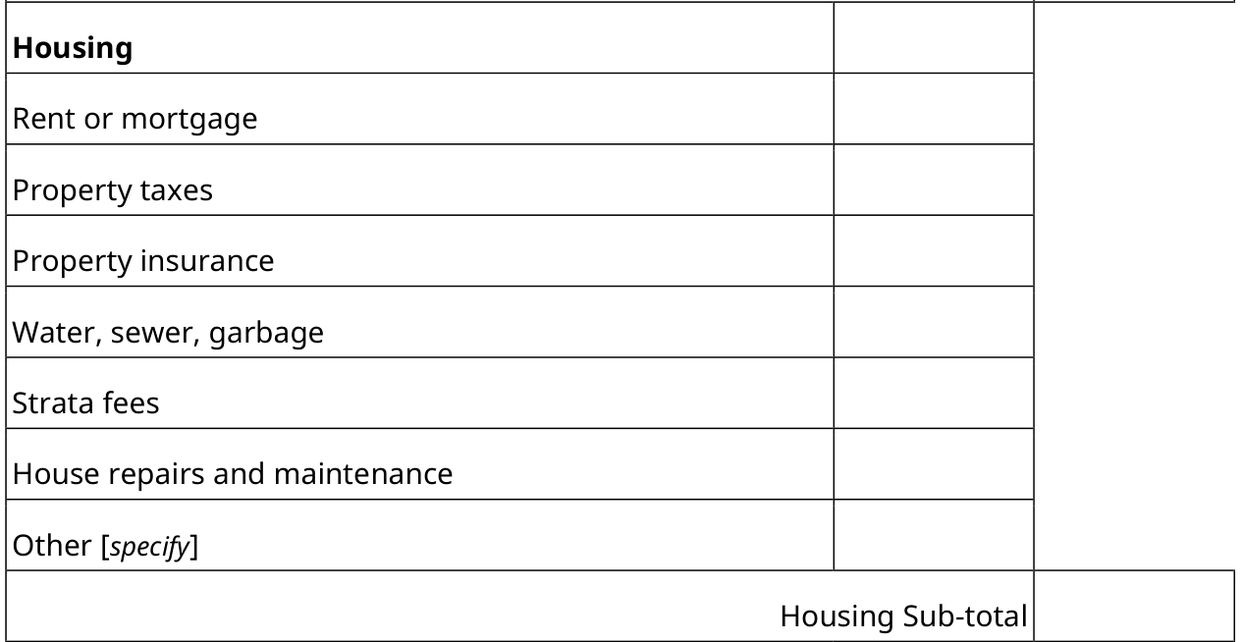
- Part 2 — Monthly expenses. Your household spending by category, monthly. Most relevant where spousal support is in issue. Categories with no matching line are the usual friction point; write-in lines exist for a reason.
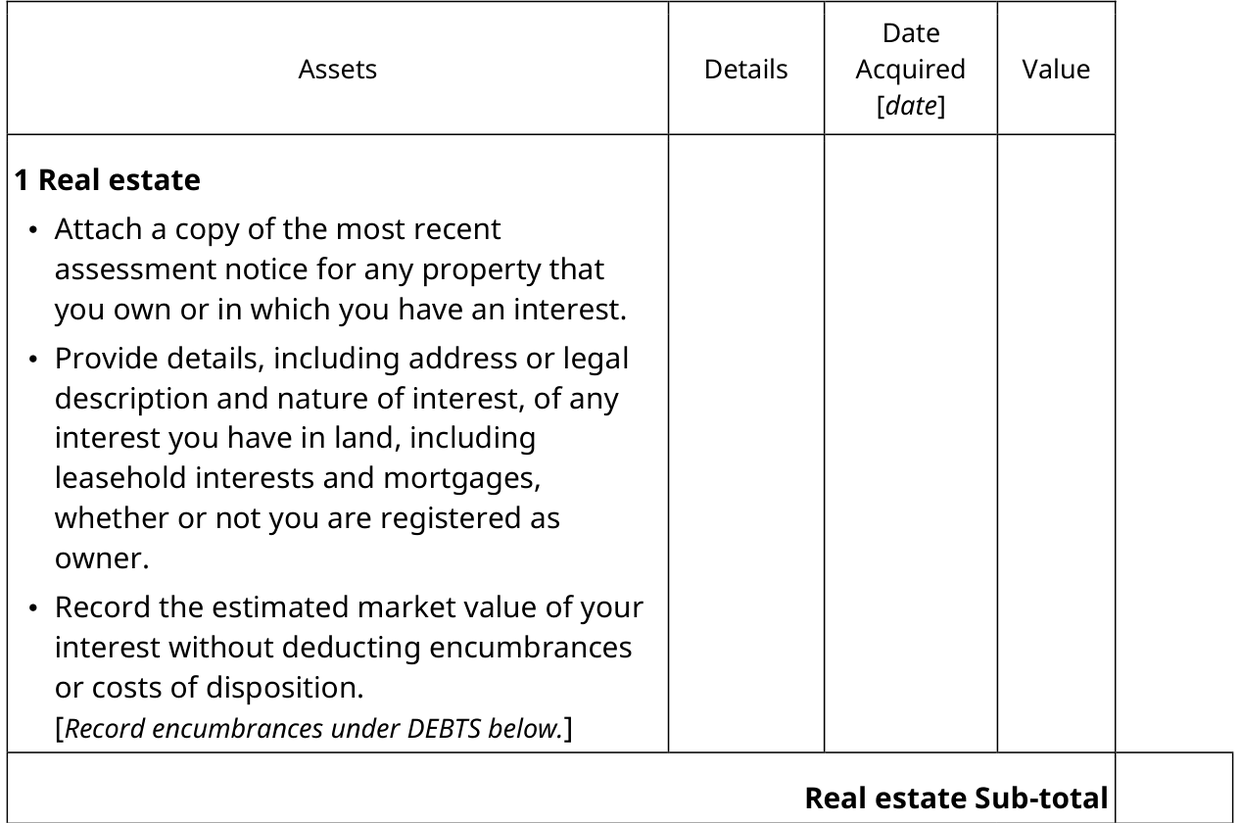
- Part 3 — Property. Assets and debts. Not everyone completes it — see when Part 3 applies below. This is also where excluded property and property that has been disposed of are addressed, both of which are legal questions rather than arithmetic.
- Part 4 — Special or extraordinary expenses. Section 7 expenses for the children — child care, medical and dental, health premiums, school, post-secondary, extracurricular. Whether an expense qualifies as a section 7 expense, and how it is shared, is a judgment call.
- The affidavit and jurat. Form F8 is sworn. The top of the form identifies which affidavit it is; the end carries the jurat — the place you swear or affirm, the date, and the signature of a commissioner for taking affidavits for British Columbia. Do not sign it before you are in front of the commissioner.
Four things on this form are legal judgment calls, not calculations: Guideline income where income is from self-employment or a corporation, excluded property, section 7 apportionment, and undue hardship. Repmyself flags each of them for you and never answers them for you. If any apply, have a BC family lawyer look at your statement before you swear it.
When Part 3 (property) has to be completed.
Part 3 is not automatic. The form sets out its own conditions, and they are easy to skim past. According to the form, Part 3 must be completed where there is a claim by or against you for spousal support; or where there is a child support claim and any of the following applies —
- ·one or more of the children is a stepchild;
- ·one or more of the children for whom child support is claimed is 19 or older;
- ·there is an application under section 9 of the child support guidelines (shared parenting);
- ·the income of the party asked to pay child support is more than $150,000 per year;
- ·a hardship claim under the guidelines has been made, by you or against you;
- ·or the child support claim is combined with a spousal support claim.
Paraphrased from the conditions printed on Form F8 itself. Read the conditions on the current form before deciding to leave Part 3 blank — and remember a property or debt division claim under Part 5 or 6 of the Family Law Act is a separate trigger for filing the statement at all.
Documents you'll want on hand.
Form F8 draws on three years of personal income tax returns and notices of assessment, plus your most recent statement of earnings. If you are self-employed, a partner in a partnership, control a corporation, or benefit from a trust, that entity's records come into it as well. Where you own or hold an interest in real property, Rule 5-1(1)(k) calls for the most recent assessment notice for each property.
Which parts of Form F8 are completed depends on the relief claimed — Rule 5-1 sets that out. Not every document applies to every person, and the official form is the checklist.
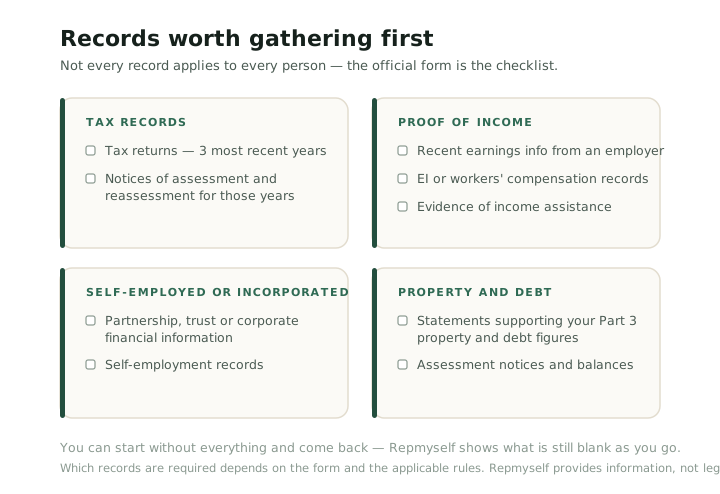
The full list, with the rule behind each item: Supporting documents for a BC financial statement →
Before you enter a figure.
- 1. Confirm the proceeding is in the Supreme Court — the heading should read “In the Supreme Court of British Columbia.”
- 2. Download the current Form F8 from the Province of BC Supreme Court family forms page or the current form in the rules.
- 3. Identify the claims involved from the filed pleadings — not the outcome you want. Repmyself explains the form's structure but can't tell you what claim to make.
- 4. Gather your income documents (tax returns, assessments, earnings, business or benefit records).
- 5. Where Part 3 applies, gather property and debt records that support your figures.
- 6. Use consistent dates and values — don't mix current, separation-date and acquisition values unless the form asks for them.
- 7. Check that every continuation schedule identifies the correct part and item.
- 8. Complete the oath or affirmation properly, before a person authorized to take affidavits.
What Repmyself does — and what it doesn't.
Repmyself can
- ✓Guide you through each part of Form F8 in plain language
- ✓Collect and organize the information you enter
- ✓Calculate totals from the figures you supply
- ✓Explain field labels neutrally and flag blank fields or technical inconsistencies
- ✓Assemble the completed statement and a checklist of commonly required documents
Repmyself does not
- ✕Decide whether Form F8 is legally required in your case
- ✕Decide which exception applies
- ✕Determine whether income should be imputed
- ✕Classify disputed property as family or excluded property, or determine ownership or value
- ✕Advise what claim or position to take, interpret evidence, or predict the court's decision
Common problems to avoid.
- Completing every part without checking the instructions — the parts required depend on the claims and the rules — follow the current form.
- Relying on the child-support exception without meeting every condition — the exception applies only if all of the listed conditions are met.
- Leaving out applicable income documents — form F8 is only one part of the disclosure package where Rule 5-1 requires supporting records.
- Using unsupported property values — record the value requested and keep the source; some values need an appraisal. Repmyself doesn't decide what valuation evidence is legally sufficient.
- Failing to update disclosure — rule 5-1 requires financial information to be kept current after a material change.
Is there a fillable Form F8 PDF?
Sort of — and this is why so many people end up frustrated. It is worth being straight about the options before you spend an evening on it.
- The government's fillable PDF is a "dynamic" (XFA) form. That format is built for desktop Adobe Acrobat. Open it in Chrome, Safari, Edge, Preview or on a phone and you will usually get a grey "Please wait… if this message is not eventually replaced" page instead of the form. Nothing is wrong with your computer — the file simply will not render in a browser. How to open it anyway →
- There is a static PDF you can print. Fine if you intend to complete it by hand, but it will not calculate anything, and Form F8 has a numbered income table and several subtotals that all have to agree.
- There is a Word version. Editable, but the tables and the numbering are unforgiving once you start adding rows, and it still does none of the arithmetic.
- None of them check your work. The most common problems with a financial statement are not typing errors — they are totals that do not reconcile, income documents that are missing, and Part 3 completed when it did not need to be, or skipped when it did.
Repmyself is the fourth option: you answer plain questions, and it produces the completed Form F8 as a filing-ready PDF plus an editable Word copy — every line and every total filled in, with the judgment calls flagged for you rather than guessed at. You can see the finished form in your browser, free, before you decide to buy anything.
Simple pricing
A financial statement is a 3–6 hour job, depending on complexity — the kind of time you'd otherwise pay a lawyer's hourly rate to do. Build and preview free; pay only when you export.
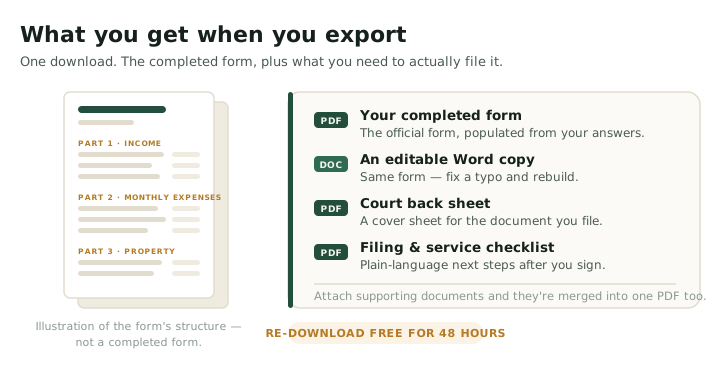
The completed Form F8 — a PDF plus an editable Word copy, populated from your answers. Re-download free for 48 hours if you spot a typo.
Build Form F8One form, one flat fee — no subscription. Launch pricing for a limited time. Want a lawyer to check it before you file? Have your statement reviewed.
Questions people actually ask.
Is Form F8 required in every Supreme Court family case?
No. It depends on the claims and the rules. Review Rule 5-1 and the instructions on the current form.
Is Form F8 an affidavit?
Yes. It is sworn or affirmed before a person authorized to take affidavits. Do not sign the affidavit section before following the commissioning instructions.
Do I always complete Parts 1, 2 and 3?
No. The required parts depend on the claims and circumstances — the chart and instructions on the current form control.
Can I leave out property I believe is excluded?
Repmyself cannot advise you to omit requested information or decide legal classification. Follow the form and rules; legal advice may be appropriate where classification is disputed.
Does Form F8 calculate support?
No. Form F8 records financial information. It does not itself decide or calculate the court's final support order.
Is my information stored?
No. Your figures live only in your browser and are sent to our server only for the moment it takes to build your document, then discarded. You can delete everything instantly.
Why won't the government's fillable F8 PDF open in my browser?
Because it is a dynamic XFA form, which is built for desktop Adobe Acrobat rather than a browser. Chrome, Safari, Edge, Preview and phones generally show a grey "please wait" placeholder instead of the form. There is also a static PDF you can print and complete by hand, and a Word version — neither calculates anything. See the options compared.
How long does Form F8 take to complete?
Realistically a few hours if your documents are already gathered — longer if you have to hunt down three years of tax returns and notices of assessment, statements for each account and debt, and receipts for children's expenses. Gathering is usually the slow part, not the typing. Our documents list is built from your own answers.
What is Guideline income, and is it just my salary?
It is the income figure used for child support under the Federal Child Support Guidelines, produced by the numbered table in Part 1(C). For straightforward employment income it is often close to your total income. Where there is self-employment, a corporation, dividends, capital gains or non-arm's-length payments, it can differ — and working it out is a legal judgment call. Repmyself flags it rather than deciding it.
Do I have to complete Part 3 (property)?
Not always. The form sets out specific conditions — a spousal support claim, or a child support claim with particular features such as a stepchild, a child 19 or older, a payor income over $150,000, a section 9 or hardship application. The conditions are listed here.
Who can swear or affirm my Form F8?
The form ends with a jurat signed by a commissioner for taking affidavits for British Columbia, and it records the place and the date you swore or affirmed it. Do not sign the form in advance — you sign it in front of the commissioner, who completes the jurat at the same time. Your court registry can tell you where you can have it commissioned.
Is Form F8 the same as Provincial Court Form 4?
No. Which one you file follows which court your case is in, not what it is about. Form F8 is the Supreme Court financial statement; Form 4 is the Provincial Court one. Support and parenting can be in either court; only the Supreme Court can grant a divorce or divide property and debt. Compare Form 4.
Where this comes from.
- Supreme Court Family Rules, B.C. Reg. 169/2009, Rule 5-1 (Financial Disclosure) and Rule 7-1 — https://www.bclaws.gov.bc.ca/civix/document/id/complete/statreg/169_2009_01
- Form F8 — Financial Statement (as enacted by B.C. Reg. 165/2024) — https://www.bclaws.gov.bc.ca/civix/document/id/complete/statreg/165_2024_FormF8
- Province of British Columbia — Supreme Court family forms — https://www2.gov.bc.ca/gov/content/justice/courthouse-services/documents-forms-records/court-forms/sup-family-forms
- Family Law Act, S.B.C. 2011, c. 25 — https://www.bclaws.gov.bc.ca/civix/document/id/complete/statreg/11025_00
- Federal Child Support Guidelines, SOR/97-175 — https://laws-lois.justice.gc.ca/eng/regulations/SOR-97-175/
This page provides general legal and procedural information for British Columbia. It does not determine whether Form F8 is required, decide which parts apply to your circumstances, or provide legal advice. Sources confirmed current as of July 2026; always check the current official form before filing.
New to financial statements?
Start with the plain-language guide: What is a financial statement in BC family law?
Form F8 sits in the Supreme Court sequence after the notice of family claim: How a Supreme Court family case starts →