Form 4 or Form F8: which financial statement do you need?
British Columbia has two family courts, and each has its own sworn Financial Statement. They are not interchangeable, they ask for different things, and the documents that go with them are not the same list.
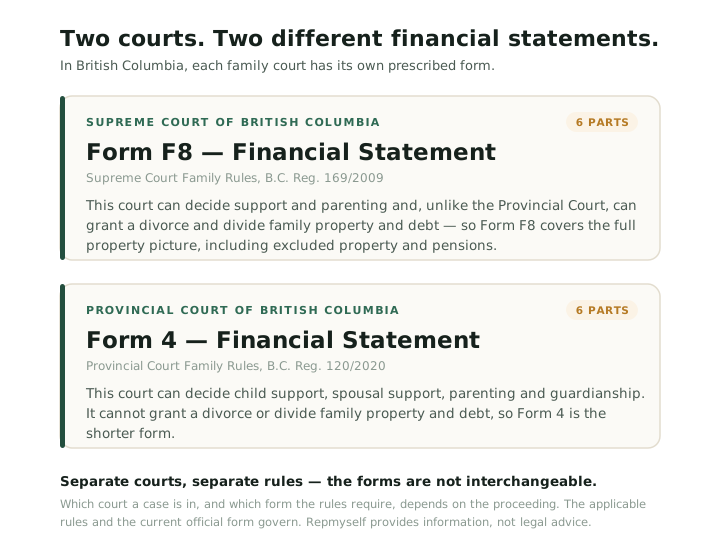
The form follows the court, not the subject. A family case in the Provincial Court of British Columbia uses Form 4. A family case in the Supreme Court of British Columbia uses Form F8.
That part is usually straightforward. The harder questions come next: which parts of the form you complete, which supporting documents have to go with it, and when it is due. Those differ substantially between the two — and that is what the rest of this page covers.
Which court is your case in?
Documents already filed in a family case name the court and the registry, usually at the top of the first page, next to the court file number. If nothing has been filed, no proceeding has been started yet — you can still prepare a financial statement, but the court has not yet been fixed.
The two courts overlap more than people expect, and differ in one decisive way:
- Both courtscan make orders about child support, spousal support, parenting arrangements and guardianship.
- Supreme Court onlycan grant a divorce, and can divide family property and family debt under Part 5 of the Family Law Act. A proceeding seeking that relief is in the Supreme Court, and so uses Form F8.
The Provincial Court generally does not decide Part 5 property claims — orders about companion animals are a limited statutory exception. Form 4 still contains an assets-and-debts section, because that information can matter to orders the Provincial Court does make.
That depends on what is being claimed and on choices that have already been made in the proceeding. If you are unsure, the court registry can confirm what has been filed in your case, or you can ask a lawyer.
Form 4
The Financial Statement used when your family case is in the Provincial Court. For an applicant, Rule 24 governs starting the application and Rule 25 adds the Form 4 requirement. For a respondent, Rule 28 governs the reply.
Build a Form 4Form F8
The Financial Statement used when your family case is in the Supreme Court. Rule 5-1 sets out which parts are filed, what counts as an applicable income document, and the time for filing and service.
Build a Form F8The two forms compared.
| Form 4 — Provincial Court | Form F8 — Supreme Court | |
|---|---|---|
| Rules | Provincial Court Family Rules, B.C. Reg. 120/2020 | Supreme Court Family Rules, B.C. Reg. 169/2009 |
| Financial statement rule | Applicant: Rule 24 governs starting the application, and Rule 25 adds the Form 4 requirement. Respondent: Rule 28 governs the reply | Rule 5-1 |
| Form name and number | Form 4, Financial Statement (PFA713) — no prefix | Form F8, Financial Statement — the “F” marks a Supreme Court form |
| Can the court grant a divorce? | No | Yes |
| Can the court divide family property and debt? | Generally no — limited statutory exceptions | Yes, under Part 5 of the Family Law Act |
| Structure | Six parts; the form states that which parts you complete depends on your situation | Six parts; Rule 5-1 assigns parts according to what is claimed, and the requirements stack |
| Supporting income documents | For child support, Rule 25(1)(b) engages the list in s. 21(1) of the Federal Child Support Guidelines | Rule 5-1(1) defines “applicable income documents” in its own list, paragraphs (a) to (k) |
| Time for filing and service | Applicant: with the application, as Rule 25 requires. Respondent: with the reply, within 30 days after service (Rule 28) — in an early resolution registry, after the Rule 11 early resolution requirements are completed | Rule 5-1(11) — within 30 days after service of the document making the claim if served in Canada or the United States, 60 days elsewhere |
| Refreshing it before a hearing | Updated disclosure may be required by the rules or by an order made in the proceeding | Rule 5-1(18) — a new Form F8 where the last one was served more than 91 days before the trial or hearing |
| Sworn or affirmed? | Yes | Yes |
Form F8 is filed in parts — and the parts stack.
Both forms have six parts, and neither is meant to be completed end to end by everybody. But the Supreme Court rule is unusually specific: Rule 5-1 assigns particular parts to particular claims, and where more than one subsection applies, the parts add together rather than replacing each other.
- Part 1Where child support is in issue — Rule 5-1(4)
- + Parts 2, 3Where the guidelines require means or ability to be considered, or the payor is a stepparent — Rule 5-1(5)
- + Part 4Where special or extraordinary expenses are claimed — Rule 5-1(6)
- Parts 1, 2, 3, 5, 6For the party claiming undue hardship; the other party files Parts 1, 2, 3 and 6 — Rule 5-1(7)
- Parts 1, 2, 3Where spousal support is in issue — Rule 5-1(9)
- Part 3Where property division under the Family Law Act is in issue — Rule 5-1(10)
So a Supreme Court case involving child support, section 7 expenses and property division does not pick one row from that list — it collects the parts from each subsection that applies.
Form 4 works differently
The Provincial Court form is organised the same way on its face — income, expenses, assets and debts, special or extraordinary expenses, income of others in the household, undue hardship — but the allocation is made by the form itself, which states that it has six parts and that which parts you must complete depends on your situation, rather than by a rule that maps parts to claims.
Completing parts the rules do not call for puts financial information before the court that the rules did not require you to give. Completing too few can leave a filing incomplete. Both are worth checking against the current rule before you file — this page describes what the rules provide, it does not determine which parts apply to your circumstances.
The two document lists are not the same.
This is the difference that most often catches people who have completed one form and assume the other works the same way. Each court starts from a different list.
Rule 5-1(1) defines “applicable income documents” for Supreme Court purposes in its own list, at paragraphs (a) to (k). It is not a cross-reference to the Federal Child Support Guidelines.
Rule 25(1)(b) requires a Form 4 from an applicant seeking a child support order where that party is required by the child support guidelines to provide income information — which brings in the document list at s. 21(1)(a) to (h) of the Federal Child Support Guidelines. Rule 25(1)(c) requires a Form 4 where spousal support is sought. Rule 25(1)(a) also calls for a copy of any existing order or written agreement the application is about.
Rule 25 addresses the applicant. A respondent’s Form 4 comes in under Rule 28, with the reply.Three differences worth knowing about
- Property assessment notices — the Supreme Court list at Rule 5-1(1)(k) reaches the most recent assessment notice for every interest in real property. Rule 5-1(12) also addresses serving it with Part 3. There is no equivalent item in s. 21(1) of the Guidelines.
- Three years of benefit statements, not one — paragraphs (c) and (d) of the Supreme Court list reach the three most recent Employment Insurance and workers’ compensation benefit statements. Section 21(1)(h) of the Guidelines asks for the most recent statement, or a letter from the authority showing the year’s total.
- Income assistance — paragraph (e) of the Supreme Court list asks for current documentary evidence, and income assistance for this purpose includes disability assistance under the Employment and Assistance for Persons with Disabilities Act.
There is also a drafting point worth noticing in Provincial Court: Rule 25(1)(b) engages the Guidelines list for child support. Where the application is for spousal support, Rule 25(1)(c) requires the Form 4 without expressly importing that document list, so the form itself governs what accompanies it. Section 21(1) of the Guidelines is by its own terms framed around a child support order.
One more Supreme Court requirement that has no Provincial Court counterpart: Rule 5-1(3) provides that every page of the income documents used in court is to be numbered sequentially.
The full document list, with the rule behind each item: Supporting documents for a BC financial statement →
In Provincial Court, the Form 4 often isn’t the first step.
In the Supreme Court, the sequence is comparatively direct: a claim is made and served, and Rule 5-1(11) provides the time for filing and serving the Form F8 — within 30 days after service of the document making the claim where service was in Canada or the United States, and 60 days elsewhere. That sequence is at How a Supreme Court family case starts.
The Provincial Court route now usually begins earlier, and not with an application at all.
Appendix 1 to the Provincial Court Family Rules was re-enacted and now designates 46 early resolution registries. In those registries the process starts with a Notice to Resolve a Family Law Matter (Form 1, PFA710) and a needs assessment before an application may be filed — Rules 9, 10 and 16.
The same regulation repealed the “family justice registry” definition in Rule 2(1) and repealed Rule 39, while preserving family justice rules for three former family justice registries — Vancouver, Kelowna and Nanaimo — under Part 13, Division 2.The practical consequence is that a Provincial Court user often meets the Form 4 later than expected: after the early resolution steps, when the Application About a Family Law Matter (Form 3) is filed, or when a Reply (Form 6) is filed in answer to one. Content written before May 2026 that describes “file Form 3 with Form 4” as the starting sequence is out of date for most BC Provincial Court readers.
Different rules apply depending on which side you are on
In Provincial Court the Form 4 requirement does not come from one rule. Which rule applies turns on whether you are starting the application or replying to one — a distinction worth getting right, because the two paths have different steps and different timing.
Rule 24 governs starting an application about a family law matter. Rule 25 then adds the Form 4 requirement: a Financial Statement is required where the applicant seeks a child support order and is required by the child support guidelines to provide income information, and where the applicant seeks a spousal support order. Rule 25(1)(a) also calls for a copy of any existing order or written agreement the application is about.
Rule 28 does not govern an applicant’s initial Form 4 — it is the reply rule.Rule 28 governs the reply. In a registry that is not an early resolution registry, a respondent files a Reply (Form 6) and, where the application is about child or spousal support, a Form 4 with it. In an early resolution registry, the respondent must first complete the early resolution requirements in Rule 11 and then file those materials. The reply and any applicable financial statement are due within 30 days after the date the party is served.
A reply may include a counter application (Rule 30). Where the counter application is about an existing order or agreement, child support, guardianship or spousal support, Rule 30(2) requires the additional documents described in Rule 25 to be filed with it — so a respondent who counter-applies comes back under the Rule 25 requirements as well.Where Form 4 fits in that sequence:
How a Provincial Court family case starts →
Application About a Family Law Matter (Form 3) →
Reply to an Application (Form 6) →
Not to be confused with.
Two form names in BC family practice are close enough to cause real filing errors.
- Supreme Court Form F4 is not a financial statement. It is the Response to Family Claim, under Supreme Court Family Rules, Rule 4-3 — a different document with a different purpose. The Provincial Court financial statement is Form 4, with no prefix. The “F” prefix marks Supreme Court forms.
- Provincial Court Form 8 is not Form F8. Provincial Court Form 8 is the Reply to a Counter Application (PFA716). The Supreme Court financial statement is Form F8. The bare number and the F-prefixed number belong to different courts.
A useful rule of thumb when reading anything about BC family forms: an F prefix means the Supreme Court Family Rules; a bare number means the Provincial Court Family Rules.
Common problems, stated neutrally.
- Filing the other court’s form — the forms are prescribed separately and are not interchangeable.
- Treating Form F8 as an all-or-nothing document — Rule 5-1 assigns parts by what is claimed, and applicable subsections combine.
- Carrying the Guidelines document list into a Supreme Court filing — Rule 5-1(1) has its own list, including the property assessment notices at paragraph (k).
- Letting a served Form F8 go stale — Rule 5-1(18) addresses a statement last served more than 91 days before a trial or hearing.
- Leaving income document pages unnumbered — Rule 5-1(3) provides for sequential page numbering of income documents used in court.
- Assuming a Provincial Court case starts with an application — in an early resolution registry the process begins earlier, with a Form 1 and a needs assessment.
- Reading “F4” as the Provincial Court financial statement — the Provincial Court form is Form 4; Supreme Court Form F4 is the Response to Family Claim.
- Working from an old version of either form — court forms are amended; use the current official version published by the Province.
Build it in plain questions.
Repmyself.ca walks through either form section by section, totals what you enter, and produces the completed official form — a PDF plus an editable Word copy — for you to review, swear and file. Build and preview free; you pay only when you export.
Form 4
For a family case in the Provincial Court of British Columbia.
Build a Form 4Form F8
For a family case in the Supreme Court of British Columbia.
Build a Form F8Want a lawyer to check it before you file? Have your statement reviewed.
Questions people actually ask.
Does it depend on what my case is about, or on which court it’s in?
The form follows the court. A family case in the Supreme Court of British Columbia uses Form F8 under the Supreme Court Family Rules; a case in the Provincial Court of British Columbia uses Form 4 under the Provincial Court Family Rules. Both courts can deal with child support, spousal support, parenting arrangements and guardianship. Only the Supreme Court can grant a divorce or divide family property and family debt under Part 5 of the Family Law Act, so a proceeding seeking that relief is in the Supreme Court and uses Form F8.
Is “Form F4” the Provincial Court financial statement?
No. The Provincial Court financial statement is called Form 4 (PFA713), with no prefix. The “F” prefix marks Supreme Court forms, and Supreme Court Form F4 is a different document entirely — the Response to Family Claim under Supreme Court Family Rules, Rule 4-3.
Do I have to complete all six parts of Form F8?
Not necessarily. Rule 5-1 sets out which parts are filed according to what is claimed — for example Part 1 where child support is in issue, Parts 1 to 3 where spousal support is in issue, and Part 3 where property division under the Family Law Act is in issue. More than one subsection can apply at once, and the parts add together rather than replacing each other.
Are the supporting documents the same for both forms?
No. Supreme Court Family Rules, Rule 5-1(1) defines “applicable income documents” in its own list at paragraphs (a) to (k). In Provincial Court, Rule 25(1)(b) engages the document list in s. 21(1) of the Federal Child Support Guidelines for child support applications. The two lists are not identical — the Supreme Court list reaches property assessment notices and three years of benefit statements, where the Guidelines list does not.
My case is in Provincial Court — is Form 4 the first thing I file?
Often not. In an early resolution registry the process begins with a Notice to Resolve a Family Law Matter (Form 1) and a needs assessment before an application may be filed. B.C. Reg. 17/2026, in force May 1, 2026, designates 46 early resolution registries. After that, which rule brings in the Form 4 depends on your side: for an applicant, Rule 24 governs starting the application and Rule 25 adds the Form 4 requirement; for a respondent, Rule 28 governs the reply, and the reply with any applicable financial statement is due within 30 days after service — in an early resolution registry, after the Rule 11 requirements are completed.
Can I file a Form F8 in Provincial Court, or a Form 4 in Supreme Court?
Each form is prescribed by its own court’s rules. Form 4 is prescribed by the Provincial Court Family Rules and Form F8 by the Supreme Court Family Rules; they are not interchangeable.
How do I find out which court my case is in?
Documents already filed in the case name the court and the registry, usually at the top of the first page, along with the court file number. If nothing has been filed yet, no proceeding has been started. If you are unsure, the court registry can confirm what has been filed, or you can ask a lawyer. Repmyself does not determine which court a case belongs in.
Is my information stored?
No. Your figures live only in your browser and are sent to our server only for the moment it takes to build your document, then discarded. You can delete everything instantly.
Where this comes from.
- Supreme Court Family Rules, B.C. Reg. 169/2009 — Rule 5-1 (financial disclosure), Rule 4-3 (response to family claim) — https://www.bclaws.gov.bc.ca/civix/document/id/complete/statreg/169_2009_01
- Provincial Court Family Rules, B.C. Reg. 120/2020 — Rule 3 (financial statements), Rules 9, 10, 11 and 16 (early resolution), Rule 24 (starting an application), Rule 25 (financial statement with an application), Rule 28 (reply), Rule 30 (counter applications) — https://www.bclaws.gov.bc.ca/civix/document/id/complete/statreg/120_2020
- B.C. Reg. 17/2026 — amendments to the Provincial Court Family Rules, in force May 1, 2026 (Appendix 1, early resolution registries) — https://www.bclaws.gov.bc.ca/civix/document/id/crbc/crbc/17_2026
- Form F8 — Financial Statement (as enacted by B.C. Reg. 165/2024) — https://www.bclaws.gov.bc.ca/civix/document/id/complete/statreg/165_2024_FormF8
- Province of British Columbia — Provincial family forms (Form 4, PFA713) — https://www2.gov.bc.ca/gov/content/justice/courthouse-services/documents-forms-records/court-forms/prov-family-forms
- Province of British Columbia — Supreme Court family forms (Form F8) — https://www2.gov.bc.ca/gov/content/justice/courthouse-services/documents-forms-records/court-forms/sup-family-forms
- Family Law Act, S.B.C. 2011, c. 25 — Part 5 (property division) — https://www.bclaws.gov.bc.ca/civix/document/id/complete/statreg/11025_00
- Federal Child Support Guidelines, SOR/97-175 — s. 21 (income disclosure) — https://laws-lois.justice.gc.ca/eng/regulations/SOR-97-175/
This page provides general legal and procedural information for British Columbia. It describes what the rules and forms provide. It does not determine which court a case belongs in, whether a financial statement is required in a particular proceeding, which parts apply to your circumstances, or what should be claimed — and it is not legal advice. Rules and forms are amended; always confirm the current requirements and use the current official form before filing. Last source review: August 2026.
New to financial statements?
Start with the plain-language guide: What is a financial statement in BC family law?
Where each form sits in the case: How a Supreme Court family case starts · How a Provincial Court family case starts