BC Provincial Court Form 3: Application About a Family Law Matter
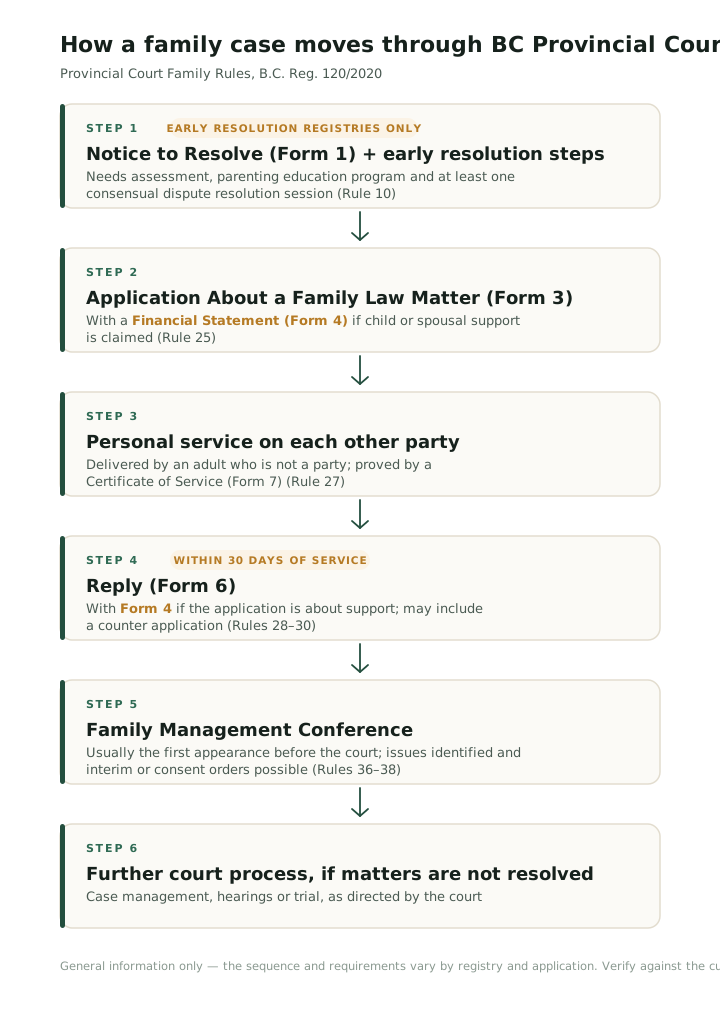
Typical sequence after filing — not every case reaches every step. Early resolution registries add a Notice to Resolve (Form 1) first.
Quick answer. Form 3, the Application About a Family Law Matter, is the court form used in the Provincial Court of British Columbia to ask for an order about a family law matter. It gives notice to each other party, and to the court, of the family law matters a person is asking the court to resolve.
This is Provincial Court Form 3 (PFA 712). It is not Supreme Court Form F3, the Notice of Family Claim.
Whether Form 3 is the first document in a case depends on the registry. In an early resolution registry, a Notice to Resolve (Form 1) and early resolution steps come first. In other registries, the case begins with Form 3 itself.
At a glance
| Form | Form 3 — Application About a Family Law Matter (PFA 712) |
|---|---|
| Court | Provincial Court of British Columbia |
| Governing rules | Provincial Court Family Rules, Rules 24 to 27 |
| Used for | Asking for a new order about a family law matter, changing or cancelling a final order, or setting aside or replacing an agreement |
| Filed by | The party applying for the order |
| Usually followed by | A Reply (Form 6), due 30 days after service |
| Financial Statement (Form 4)? | Sometimes — with child support and spousal support applications (Rule 25) |
| Filing fee | None — the form instructions state there are no fees for filing Provincial Court family documents |
What is a "family law matter"?
The rules define the term. In the words of Rule 2(1), a family law matter means a case about one or more of the following:
- parenting arrangements, including parental responsibilities and parenting time;
- child support;
- contact with a child;
- guardianship of a child;
- spousal support;
- property division in respect of a companion animal.
Some family law issues use different forms. The instructions on Form 3 identify Form 12 for a protection order, Form 15 for a priority parenting matter, and a Request for Scheduling (Form 39) to change an interim order. Division of family property other than a companion animal is not a Provincial Court family law matter — those claims proceed in the Supreme Court of British Columbia.
What Form 3 is used for
Rule 24(1) describes three kinds of orders an application may ask for: a new order about a family law matter; an order to change or cancel all or part of an existing final order (other than property division in respect of a companion animal); or an order to set aside or replace all or part of an agreement. The filing requirement itself, in the rule's own words:
"To apply for an order about a family law matter in a registry other than an early resolution registry, a party must file and serve on each other party an application about a family law matter in Form 3."
In an early resolution registry, Rule 24(3) requires the early resolution requirements to be met first — see the registry tracks below.Sometimes. Rule 25 requires a Financial Statement (Form 4) with the application where it is about spousal support, or about child support where the child support guidelines require income information. Read the Form 4 guide →
Where Form 3 fits in the process
Form 3 is the document that formally asks the Provincial Court to make or change certain family law orders. Depending on the registry and the type of application, other steps or documents may be required before or after it is filed. The full sequence, step by step and tied to the rule at each stage, is at How a Provincial Court family case starts.
The two registry tracks
Early resolution registries
The registries listed in Appendix 1 of the rules are early resolution registries. Appendix 1 was re-enacted by B.C. Reg. 17/2026 and now lists 46 registries — including Abbotsford, Kamloops, Kelowna, Nanaimo, New Westminster, Richmond, Surrey, Vancouver (Robson Square), Vernon and Victoria. Before filing an application there, Rule 10 requires the steps below, in the rule's own words:
"Before filing an application about a family law matter under Part 3, a party seeking resolution of a family law matter in an early resolution registry must, unless otherwise provided in these rules, (a) file a notice to resolve in Form 1, (b) provide a copy of the notice to resolve to each other party, (c) participate in a needs assessment under rule 16, (d) complete a parenting education program under rule 17, and (e) participate in at least one consensual dispute resolution session under rule 18."
Parenting education program registries
All other registries are parenting education program registries (Rule 6(c)). In these registries a party files and serves Form 3 without the early resolution steps (Rule 24(2)), and completion of the parenting education program is addressed before a family management conference is scheduled. The current Appendix 1 list should always be checked — registry designations change by regulation.
Documents filed with Form 3
Rule 25(1) lists the additional documents, in the rule's own words:
"A party must file the following additional documents with an application about a family law matter: (a) for an order about an existing order or written agreement, a copy of the existing order or written agreement; (b) for an order about child support, if the party is required under the child support guidelines to provide income information, a financial statement in Form 4, and any applicable information and documents described in Form 4 as required under the child support guidelines; (c) for an order about spousal support, a financial statement in Form 4."
Rule 25(2) and Rule 26 add further requirements for guardianship applications, including record checks and a Guardianship Affidavit (Form 5).
How Form 3 is organized
The official form (PFA 712, version 05/2026) consists of a four-page main application and separate schedules. The main application includes parts addressing:
- notice of the application and who must be served;
- identification of the parties, and the relationship between them — including dates of cohabitation, marriage and separation, as applicable;
- identification of any children, and an acknowledgment of the best-interests-of-the-child test in section 37 of the Family Law Act;
- the family law matters the applicant is asking the court to resolve;
- the filing location and initial requirements;
- a lawyer's statement, where applicable, and an address for service.
For each family law matter selected, the form directs the applicant to a schedule. Which schedule applies depends on whether a final order or written agreement about that matter already exists.
How Form 3 is served
Rule 27 requires personal service: an adult who is not a party must leave with the person being served a copy of the application, instructions from the registry about how to file a reply and obtain Form 6, and any additional documents filed under Rules 25 and 26 — including any Form 4. The person who serves the documents completes a Certificate of Service (Form 7).
What happens after service
The rules set out what follows once the application has been served. The deadline, in the rule's own words:
"A reply and, if applicable, a financial statement must be filed by a party within 30 days after the date that the party is served the application about the family law matter."
- The reply can agree, disagree, or ask for something different. Rule 29 permits the replying party to agree with one or more of the orders applied for, to disagree, or to include a counter application about a different family law matter (Rule 30).
- The registry, not the applicant, distributes the reply. Rule 33 requires the registry to provide a copy of the reply and its documents to the applicant within 21 days after filing.
- If no reply is filed, the case does not automatically end. In the words of Rule 31, the party "is not entitled to receive notice of any part of the proceedings, including any court appearance," and "a judge or family justice manager may make orders in the absence of the party." Rule 32 preserves a discretion to direct that the party receive notice and attend.
- The first appearance is usually a family management conference. The form instructions state that a family management conference is usually the first appearance before the court; Rules 36 to 38 describe its purpose and scheduling. A family settlement conference is a later, separate process under Part 8 if the court directs one — it is not automatic.
Common preparation issues
The form instructions and rules address several recurring issues. Stated neutrally, they include:
- filing an application in an early resolution registry before the Rule 10 requirements have been met — the rules make those steps a precondition to filing;
- omitting a Financial Statement (Form 4) where Rule 25 requires one with the application;
- omitting a schedule that the form directs must be completed for a family law matter selected in the application;
- service that does not meet Rule 27 — the documents must be personally served by an adult who is not a party, and the package must include the registry's reply instructions and any additional documents;
- asking the Provincial Court to divide family property other than a companion animal — those claims proceed in the Supreme Court of British Columbia under different rules and forms;
- using Form 3 where the form instructions direct a different form — a protection order (Form 12), a priority parenting matter (Form 15), or a change to an interim order (Request for Scheduling, Form 39).
Applying or replying about support? Form 4 travels with your documents.
RepMyself's free builder organizes your own income, expense, asset and debt information into the Provincial Court Form 4 layout — everything stays in your browser.
Start your Form 4 — freeFrequently asked questions
Is Form 3 always the first document in a case?
No. In an early resolution registry, the Notice to Resolve (Form 1) and the early resolution requirements come first. In other registries, the case starts with Form 3.
Can Form 3 be changed after it is filed?
Yes. Rule 188 permits a party to change anything in a filed application without a court order before the first family management conference, and at any time after that with a court order or the consent of the parties. The changed document must be marked as changed, show the additions and deletions, and be served (Rule 189); the rules also provide for a reply to a changed document (Rule 190).
Can Form 3 be withdrawn?
Yes. Rule 191 permits a party to discontinue all or part of an application by filing a Notice of Discontinuance (Form 50) and serving it on each other party within the timelines set out in that rule. Timing restrictions apply once a trial preparation conference or trial date is scheduled.
Can Form 3 be filed online?
Yes. The form instructions state that most family forms can be completed and filed electronically using the Family Law Act Online Forms Service, or filed in person, by mail, or by the other methods the instructions describe.
Can the other party be served outside British Columbia?
The rules permit it in defined circumstances. Rule 186 allows service outside British Columbia where the order sought is within the court's jurisdiction under section 10 of the Court Jurisdiction and Proceedings Transfer Act or under Division 7 or 8 of Part 4 of the Family Law Act. Whether those provisions apply in a given case is a jurisdictional question the rules do not answer in general terms.
What if the other party cannot be found?
Rule 182 permits a party to apply for an order allowing service by a peace officer or by an alternative method where the court is satisfied the person cannot be found after a diligent search, is evading service, or is temporarily outside British Columbia. The form instructions identify Form 11 as the application used for that request.
Is Form 3 the same as Supreme Court Form F3 (Notice of Family Claim)?
No. They are different documents in different courts. Form 3 (PFA 712) is the Application About a Family Law Matter under the Provincial Court Family Rules. Supreme Court Form F3 is the Notice of Family Claim under the Supreme Court Family Rules. Supreme Court family forms carry an F prefix; Provincial Court family forms do not. The Supreme Court sequence starts at How a Supreme Court family case starts.
If I already have a lawyer, can I still use RepMyself?
Yes. RepMyself can be used whether or not a person is represented. Organizing and entering your own financial information with the tool can reduce the time — and therefore the billable hours — a lawyer would otherwise spend assembling it. Anything prepared with the tool should be reviewed with your lawyer before it is sworn or filed.
Related guides
- How a Provincial Court family case starts
- What happens at a Family Management Conference
- What happens at a Family Settlement Conference
- Reply to an Application About a Family Law Matter (Form 6)
- Form 4 Financial Statement: plain-language guide
- Form 4 or Form F8: which financial statement?
- Supporting documents for a BC financial statement
- What is a financial statement in BC family law?
Official resources
- Provincial family court forms — gov.bc.ca/court-forms (Form 3 and guidebook, PFA 712)
- Family Law Act Online Forms Service
- Family Justice Services Division
Sources
- Provincial Court Family Rules, B.C. Reg. 120/2020, Rules 2(1), 6, 10, 16–18, 24–34, 36–38, 182, 186, 188–192 and Appendix 1 (as amended, including B.C. Reg. 17/2026) — BC Laws. Quoted passages reproduce the rules as published (bracketed rule-title cross-references omitted).
- Application About a Family Law Matter, Form 3 (PFA 712, version 05/2026), including form instructions — Government of British Columbia court forms.
- Family Law Act, S.B.C. 2011, c. 25, s. 37 (best interests of the child), as referenced on the form.
Last source review: August 2, 2026. Quotations are from the Provincial Court Family Rules as published on BC Laws; the rules and forms change — always confirm against the current versions before filing.