How a Provincial Court family case starts.
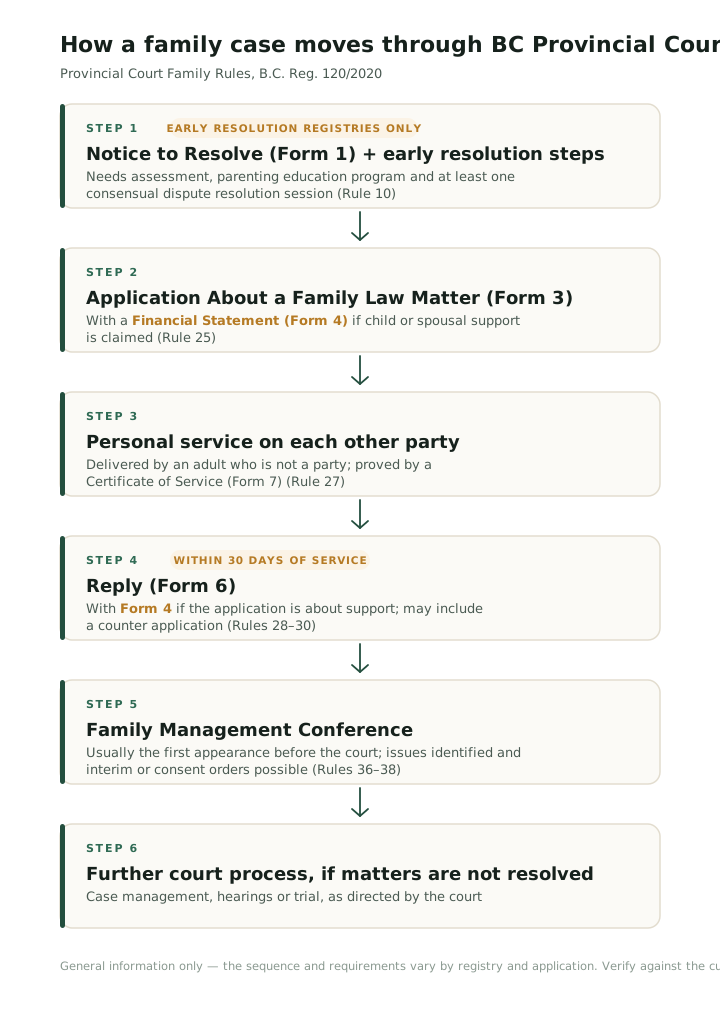
A Provincial Court family case follows a set sequence, and most of it happens before anyone sees a courtroom. This page maps that sequence step by step, and ties each step to the rule that sets it.
Where you start depends on which registry your case is in. In an early resolution registry — there are now 46 of them — several steps come before an application can be filed at all. In every other registry, the case starts with the application itself.
From there the path is common to both: the application is served, the other party replies, and the parties attend a family management conference. The rules for that conference apply in every registry.
1Which registry is your case in?
This is the question that decides everything that follows, and it is answered by geography rather than by the subject of your case. The Provincial Court Family Rules divide registries into two kinds, and the first steps are completely different in each.
Appendix 1 to the Provincial Court Family Rules was re-enacted and now designates 46 early resolution registries — among them Abbotsford, Kamloops, Kelowna, Nanaimo, New Westminster, Richmond, Surrey, Vancouver (Robson Square), Vernon and Victoria. Under Rule 6(c), every other registry is a parenting education program registry.
The same regulation repealed the “family justice registry” definition in Rule 2(1) and repealed Rule 39, while preserving family justice rules for three former family justice registries — Vancouver, Kelowna and Nanaimo — under Part 13, Division 2. Material written before May 2026 that describes a separate “family justice registry” track is out of date.Because the early resolution list now runs to 46 registries, the early resolution track is the ordinary route for most people in British Columbia, not the exception.
Early resolution registry
- File a notice to resolve in Form 1
- Give a copy to each other party
- Participate in a needs assessment (rule 16)
- Complete a parenting education program (rule 17)
- Attend at least one consensual dispute resolution session (rule 18)
- Then the Form 3 application may be filed
Parenting education program registry
A party files and serves the Form 3 application without the early resolution steps. Completion of the parenting education program is dealt with later — under Rule 40, the registry may not schedule a family management conference unless at least one party has filed a certificate of completion of a parenting education program, or a notice of exemption in Form 20.
2The early resolution steps.
In an early resolution registry these are not optional preliminaries — the rule makes them a precondition to filing an application at all.
“Before filing an application about a family law matter under Part 3, a party seeking resolution of a family law matter in an early resolution registry must, unless otherwise provided in these rules, (a) file a notice to resolve in Form 1, (b) provide a copy of the notice to resolve to each other party, (c) participate in a needs assessment under rule 16, (d) complete a parenting education program under rule 17, and (e) participate in at least one consensual dispute resolution session under rule 18.”
A respondent has a parallel obligation. Under Rule 28(3), a party replying to an application filed in an early resolution registry must meet the early resolution requirements described in rule 11, and only then file the reply materials.
These requirements can also come back later in the process. Under Rule 49, a judge or family justice manager at a family management conference may order a party to complete the early resolution requirements described in rule 10, or the parenting education program registry requirements described in rule 100.
3The application — Form 3.
The Application About a Family Law Matter is the document that starts the court process.
“To apply for an order about a family law matter in a registry other than an early resolution registry, a party must file and serve on each other party an application about a family law matter in Form 3.”
Rule 25 adds documents that must go with the application in particular cases — including a Form 4 Financial Statement for an order about child support, where the applicant is required by the child support guidelines to provide income information, and for an order about spousal support. Rule 25(1)(a) also calls for a copy of any existing order or written agreement the application is about. Rule 25(2) and Rule 26 add further requirements for guardianship applications, including record checks and a Guardianship Affidavit in Form 5.
The form itself, section by section: Application About a Family Law Matter (Form 3) →
4Serving the application.
Filing is only half of it. The application has to reach the other party in the way the rules require, and the manner of service is prescribed rather than left to choice.
Rule 27 requires personal service: an adult who is not a party must leave with the person being served a copy of the application, the registry’s instructions about how to file a reply and obtain Form 6, and any additional documents filed under Rules 25 and 26 — including any Form 4.
The person who serves the documents completes a Certificate of Service in Form 7.The certificate is not merely a formality. It is the document the registry looks to when the next stage depends on when service happened — Rule 38(b) keys the scheduling of a family management conference in an unanswered case to the date shown on the certificate of service.
5The reply — Form 6.
A party who is served may reply. What that involves again depends on the registry.
- Not an ERRFile a reply in Form 6, and where the application is about child or spousal support, a Form 4 with it — Rule 28(2).
- In an ERRMeet the early resolution requirements in rule 11 first, then file those same materials — Rule 28(3).
- DeadlineThe reply and any applicable financial statement must be filed within 30 days after the date the party is served — Rule 28(4).
- Counter applicationA reply may include a counter application (Rule 30). Where it is about an existing order or agreement, child support, guardianship or spousal support, Rule 30(2) requires the additional documents described in Rule 25 to be filed with it.
“If a party does not file a reply within 30 days in accordance with rule 28 … (a) the party is not entitled to receive notice of any part of the proceedings, including any court appearance, and (b) a judge or family justice manager may make orders in the absence of the party.”
The reply form in detail: Reply to an Application About a Family Law Matter (Form 6) →
6The family management conference.
For most people this is the first time the case comes before a judge or a family justice manager. Part 4 of the rules governs it, and Rule 35 provides that those rules apply in all registries — the conference is not something only early resolution registries do.
An informal and time-limited process in which the judge or family justice manager assists the parties to identify the issues to be resolved, explores options to resolve them, is able to make case management orders and directions to ensure the file is ready to proceed to the next step, is able to make interim orders under rule 50, and is able to make orders where no reply was filed (rule 31), by consent (rule 52), or in the absence of a party (rules 54 and 55).
Rule 36(2): a judge at a family management conference may make any other orders or directions as appropriate, in addition to the case management orders.How it gets scheduled
- Reply filedWhere an application and a reply have been filed, the registry must provide the parties with information about the procedure for scheduling — Rule 37.
- No replyWhere no reply was filed, at least 30 days have passed since service based on the certificate of service, and any early resolution requirements under rule 10 have been met, the registry must provide that information to the applying party — Rule 38.
- PE registryIn a parenting education program registry, no conference may be scheduled unless at least one party has filed a certificate of completion or a notice of exemption in Form 20 — Rule 40.
- After a yearWhere more than a year has passed with no step taken and no final order, a notice of intention to proceed in Form 2 must be filed and served, and the parties must participate in a conference — Rule 42.
Who attends
Rule 43 provides that where a conference is scheduled, all parties to the application must attend. Rule 44 provides that a lawyer for each party may attend with the party. Rule 45 provides that the conference may proceed without a party who does not file a reply, or who does not attend.
What the conference may consider
The judge or family justice manager may require a party to provide, for consideration: (a) information provided in an application, reply and reply to counter application; (b) evidence provided in a financial statement; (c) evidence given orally on oath or affirmation; (d) affidavit evidence; and (e) submissions.
What can come out of it
- Rule 50Interim orders — including about parental responsibilities, parenting time, child support, contact with a child, guardianship, spousal support, and property division in respect of a companion animal.
- Rule 51An interim guardianship order may be made without a Form 5 affidavit where it is in the child’s best interests; unless renewed, it expires 90 days after it is made.
- Rule 52Orders by consent, including final orders on the same list of subjects. A family justice manager may not make a final order about guardianship.
- Rule 53Conduct orders available under Division 5 of Part 10 of the Family Law Act, with limits on what a family justice manager may make.
- Rules 54, 55Orders in the absence of a party — a judge may make a final order in a party’s absence; a family justice manager may not. An absent party applies to change one using Form 10, at least 7 days before the appearance.
- Rule 56Directions to participate in consensual dispute resolution, return for another conference, or attend a family settlement conference, trial preparation conference, hearing or trial.
It describes what the rules provide about the conference. It does not advise what to say at one, what position to take, what to agree to, or how to respond to the other party — those are matters for independent legal advice.
The full Part 4 deep dive — purpose, attendance, what the court may consider, orders, and next steps: What happens at a Family Management Conference →
Where the Form 4 Financial Statement fits.
Financial disclosure is not a separate track running alongside the case — it attaches at specific points in the sequence above.
- ApplicationRule 25 — with a Form 3 seeking child support (where guidelines income information is required) or spousal support.
- ReplyRule 28(2)(b) — with a Form 6 where the application is about child or spousal support.
- Counter applicationRule 30(2) — the Rule 25 additional documents are required with a counter application on those subjects.
- ConferenceRule 46(b) — evidence provided in a financial statement is among the material the conference may require.
Form 4 or Form F8 — which financial statement do you need? →
The Form 4 plain-language guide →
Supporting documents for a BC financial statement →
Common problems, stated neutrally.
- Assuming the case starts with the application — in an early resolution registry, Rule 10 requires several steps before an application may be filed.
- Relying on pre-May-2026 material — B.C. Reg. 17/2026 re-enacted Appendix 1, repealed Rule 39 and repealed the “family justice registry” definition. Older descriptions of the registry scheme are stale.
- Treating service as informal — Rule 27 requires personal service by an adult who is not a party, and a Certificate of Service in Form 7 records it.
- Losing track of the service date — the 30-day reply period in Rule 28(4) and the scheduling step in Rule 38(b) both run from it.
- Not replying — Rule 31 provides that a party who does not reply within 30 days is not entitled to notice of any part of the proceedings, and orders may be made in that party’s absence.
- Filing a counter application without its documents — Rule 30(2) requires the Rule 25 additional documents where the counter application is about an existing order or agreement, child support, guardianship or spousal support.
- Expecting the conference to be scheduled automatically in a parenting education registry — Rule 40 gates it on a certificate of completion or a Form 20 exemption.
- Letting a file go quiet for over a year — Rule 42 then requires a notice of intention to proceed in Form 2 and a family management conference before proceeding.
Questions people actually ask.
What is the first step in a BC Provincial Court family case?
It depends on the registry. In an early resolution registry, Rule 10 requires a party to file a notice to resolve in Form 1, give a copy to each other party, participate in a needs assessment under rule 16, complete a parenting education program under rule 17, and participate in at least one consensual dispute resolution session under rule 18 — all before an application about a family law matter may be filed. In every other registry, which Rule 6(c) makes a parenting education program registry, Rule 24(2) provides that a party files and serves an application about a family law matter in Form 3.
How many early resolution registries are there in BC?
Appendix 1 to the Provincial Court Family Rules was re-enacted by B.C. Reg. 17/2026, in force May 1, 2026, and designates 46 early resolution registries. The same regulation repealed the “family justice registry” definition in Rule 2(1) and repealed Rule 39, while preserving family justice rules for three former family justice registries — Vancouver, Kelowna and Nanaimo — under Part 13, Division 2.
How is a Form 3 application served?
Rule 27 requires personal service. An adult who is not a party must leave with the person being served a copy of the application, the registry’s instructions about how to file a reply and obtain Form 6, and any additional documents filed under Rules 25 and 26 — including any Form 4 Financial Statement. The person who serves the documents completes a Certificate of Service in Form 7.
How long does the other party have to reply?
Rule 28(4) provides that a reply and, if applicable, a financial statement must be filed within 30 days after the date the party is served the application. In an early resolution registry, Rule 28(3) requires the replying party to meet the early resolution requirements described in rule 11 first, and then file. If no reply is filed within 30 days, Rule 31 provides that the party is not entitled to receive notice of any part of the proceedings, and a judge or family justice manager may make orders in the absence of that party.
What is a family management conference?
Rule 36(1) describes it as an informal and time-limited process in which a judge or family justice manager assists the parties to identify the issues to be resolved, explores options to resolve them, and is able to make case management orders, interim orders under rule 50, and orders by consent under rule 52. Rule 35 provides that the family management conference rules apply in all registries.
Do I have to attend the family management conference?
Rule 43 provides that if a family management conference is scheduled, all parties to an application about a family law matter must attend. Rule 44 provides that a lawyer for each party may attend with the party. Rule 45 provides that a family management conference may proceed without a party who does not file a reply, or who does not attend.
Where does the Form 4 Financial Statement fit into this?
Rule 25 requires a Form 4 with an application about child support, where the applicant must give income information under the child support guidelines, and about spousal support. Rule 28(2)(b) requires one with a reply where the application is about child or spousal support. Under Rule 46(b), evidence provided in a financial statement is among the material a judge or family justice manager may require the parties to provide for consideration at a family management conference.
What if more than a year has passed without any step being taken?
Rule 42 provides that where an application about a family law matter has been filed, there is no final order in respect of it, and more than one year has passed since the parties have taken any step under the rules, a party must file a notice of intention to proceed in Form 2, serve it on each other party and file a certificate of service, and the parties must participate in a family management conference before the party may proceed.
Where this comes from.
- Provincial Court Family Rules, B.C. Reg. 120/2020 — Rule 6 (registry types), Rules 10, 11, 16, 17, 18 (early resolution), Rules 24–27 (application and service), Rules 28–31 (reply, counter application), Part 4, Rules 35–57 (family management conferences), Appendix 1 — https://www.bclaws.gov.bc.ca/civix/document/id/complete/statreg/120_2020
- B.C. Reg. 17/2026 — amendments to the Provincial Court Family Rules, in force May 1, 2026 — https://www.bclaws.gov.bc.ca/civix/document/id/crbc/crbc/17_2026
- Province of British Columbia — Provincial family forms (Form 1 PFA710, Form 3 PFA712, Form 4 PFA713, Form 6 PFA715) — https://www2.gov.bc.ca/gov/content/justice/courthouse-services/documents-forms-records/court-forms/prov-family-forms
- Family Law Act, S.B.C. 2011, c. 25 — Part 10 (court processes), s. 51 (guardianship) — https://www.bclaws.gov.bc.ca/civix/document/id/complete/statreg/11025_00
This page provides general legal and procedural information for British Columbia. It describes what the Provincial Court Family Rules provide. It does not determine which registry or court a case belongs in, what steps apply to a particular proceeding, what a party should say or agree to at a family management conference, or what position anyone should take — and it is not legal advice. Rules and forms are amended; always confirm the current requirements against the Provincial Court Family Rules before acting. Last source review: August 2026.