How to write an affidavit for BC family court.
An affidavit is your evidence, written down and sworn. It is not a letter to the judge, and it is not your argument. That single distinction decides most of what belongs in one — and almost everything that gets ignored. This page sets out what the BC family rules allow in an affidavit, what routinely gets struck or given no weight, and how hearsay, exhibits and length work differently in each court.
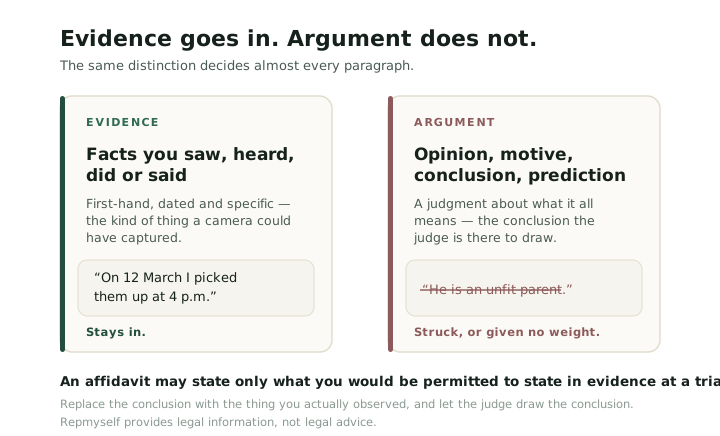
An affidavit may contain only what you would be allowed to say from the witness box at a trial. That is the test in both BC family courts — Rule 10-4 (12) of the Supreme Court Family Rules and Rule 171 (5) of the Provincial Court Family Rules. In practice it means facts you personally saw, heard, did or said, that are relevant to the application actually before the court.
Your opinion of the other party, your conclusions about their motives, your predictions, your feelings about what happened, and the reasons you should win are not evidence. They are argument — and argument belongs in what you say to the judge, not in a sworn document.
On this page
- The one rule everything else follows from
- What actually goes in
- The lines that get struck — and what to write instead
- When you can write what someone else told you
- Exhibits — and why attaching a document is not enough
- Length, format and what you may not attach
- Swearing it, changing it, and filing it unsworn
- What happens when an affidavit breaks the rules
1The one rule everything else follows from.
There is no separate, lower standard for evidence written down. An affidavit stands in place of you giving oral testimony, so it is held to the same limits. Both sets of BC family rules say so in almost identical words.
“Subject to subrule (13), an affidavit must state only what a person swearing or affirming the affidavit would be permitted to state in evidence at a trial.”
“Subject to subrule (6), an affidavit must state only what a person swearing or affirming the affidavit would be permitted to state in evidence at a trial.”
Everything below is an application of that one sentence. A witness in the box may describe what they saw, heard, did and said. A witness may not tell the judge what the other party was thinking, what a document means, what is fair, what should happen next, or what the law is. Those are matters for the judge to decide, after hearing argument — and a sworn statement is not the place for them.
Even a perfectly admissible fact does not belong in the affidavit if it has nothing to do with the application in front of the court. The Provincial Court's own guidebook for Form 45 puts it plainly: include only facts that are relevant to your case — information that can be used to prove or disprove an important fact or issue. A long affidavit about the history of the relationship, filed on an application about a specific parenting schedule, mostly answers a question nobody asked.
2What actually goes in.
The rules set out the shape of the document. Both courts require the same core things, with the Provincial Court adding explicit numbering requirements.
Form F30
- Expressed in the first person, showing your name, address and occupation
- If you are a party — or a party's lawyer, agent, director, officer or employee — it must say so
- Divided into paragraphs numbered consecutively
- May be in Form F30
- The top right corner of the first page must show your name, the sequential number of the affidavit you have made in that case, and the date it was made
Form 45 (PFA762)
- Unless a rule provides otherwise, it must be in Form 45
- Expressed in the first person, including your name, address and occupation
- It must state whether you are a party, or a party's lawyer, agent, director, officer or employee
- Divided into paragraphs numbered consecutively, and it must have page numbers
- If there are exhibits, the exhibits must have page numbers too
The content itself
Inside that structure, an affidavit is a plain chronological account of relevant facts within your own knowledge. Useful habits, most of which come straight from the Provincial Court's Form 45 guidebook:
- One fact per paragraph. Short sentences. A judge and the other party need to be able to admit, deny or answer each paragraph on its own.
- Dates, not impressions. "On 12 March 2026" carries weight; "around that time" invites a fight about whether it happened at all.
- Names, not pronouns. Once three people are in the story, "he" and "she" stop being clear.
- Your own words. An affidavit that reads as though a lawyer wrote it makes it harder, not easier, to assess. Write it the way you would say it.
- Say what you saw, heard, did or said. If you did not personally perceive it, either leave it out or identify where it came from — see hearsay below.
- Reference every exhibit in the body. A document attached to the back that no paragraph mentions is doing nothing.
3The lines that get struck — and what to write instead.
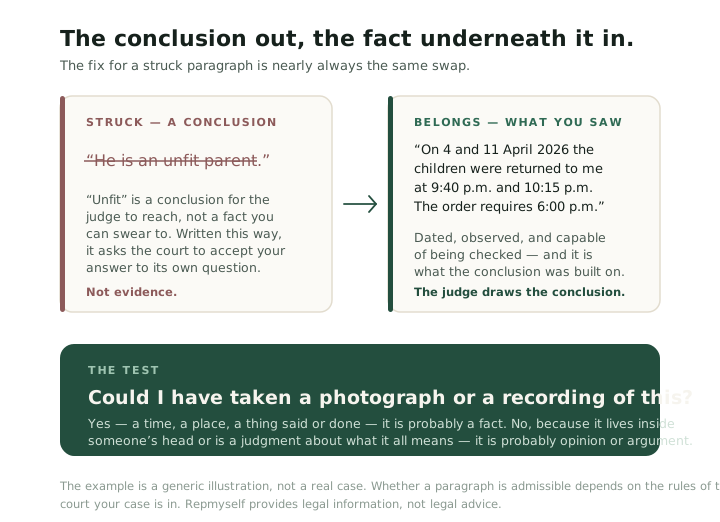
Almost every problem paragraph is one of a small number of recurring moves: giving an opinion, guessing at someone's motive, arguing, predicting, or hedging instead of stating a fact. The fix is nearly always the same — replace the conclusion with the thing you actually observed that led you to it, and let the judge draw the conclusion.
| Instead of writing | Write the underlying fact | Why |
|---|---|---|
| "He is an unfit parent." | "On 4 and 11 April 2026 the children were returned to me at 9:40 p.m. and 10:15 p.m. The order requires 6:00 p.m." | "Unfit" is a conclusion for the judge. The late returns are facts you observed, and they are what the conclusion was built on. |
| "She is deliberately hiding income." | "Her 2025 tax return shows $41,000. The 14 June 2026 bank statement attached as Exhibit C shows deposits of $9,200 that month." | Intent is not something you can perceive. Set out the figures and the documents; the inference is the court's to draw. |
| "He only wants more parenting time to reduce his support." | "On 2 May 2026 he texted me: 'if I have them half time I pay you nothing.' The message is attached as Exhibit D." | Another person's motive is not within your knowledge. What they actually wrote or said is. |
| "I was shocked and disgusted by her behaviour." | "She arrived at my door at 11:20 p.m. on 3 June 2026 and knocked for about ten minutes." | Your emotional reaction is not a fact in issue. The event is. |
| "He will never bring them back on time." | "Of the twelve exchanges between January and June 2026, he was more than an hour late on seven: 12 and 26 January, 9 February, 23 March, 6 and 20 April, and 4 May 2026." | A prediction about the future is not evidence. Past conduct is, and it is what lets a court draw its own conclusion about the future. |
| "My daughter is anxious about going to his house." | "On the last four exchanges my daughter cried in the car and asked to stay home." Or, if the rule on hearsay is met, what she told you and when. | You cannot swear to another person's internal state. You can swear to what you observed, or to what you were told, with the source identified. |
| "It is clearly unfair that I have to pay this." | Nothing — delete it. | Fairness is the question the judge is deciding. Arguing it in a sworn document does not make the argument evidence. |
| "The case law says a parent in my position gets primary residence." | Nothing — delete it. | The law is not a fact you can swear to. Legal submissions belong in what you say to the court, not in your affidavit. |
| "To the best of my knowledge he was not working." "I understood that he had moved." "I believe she cancelled the policy." |
Either state it as a fact you know — "He told me on 6 May 2026 that he had stopped working" — or identify where the information came from and say you believe it to be true. | These hedges usually signal that the statement is not within your own knowledge. If it is not, the hearsay rule applies and the source has to be named. |
| "Everyone knows he has a drinking problem." "I have been told by several people that…" |
"On 9 July 2026 [name] told me that…, and I believe that information to be true." | An unnamed source cannot be assessed or answered. Both courts' hearsay exceptions require the source of the information to be given. |
| "He constantly harasses me with an endless stream of abusive messages." | "Between 1 and 14 August 2026 he sent me 63 text messages. They are attached as Exhibit F." | Adjectives and intensifiers are argument in disguise. The count and the exhibit are stronger and cannot be argued with. |
| "I have read his affidavit and deny everything in it except where expressly admitted." | Answer the specific paragraphs: "Paragraph 14 is not correct. I did not attend the school on 8 May 2026; I was at work, and my timesheet is Exhibit B." | A blanket denial is a pleading technique, not evidence. It tells the court nothing about which facts are actually in dispute. |
Read each paragraph and ask: could I have taken a photograph or a recording of this? If the answer is yes — a time, a place, a thing said, a thing done — it is probably a fact. If the answer is no, because it lives inside someone's head or is a judgment about what it all means, it is probably opinion or argument, and it does not belong in the affidavit.
4When you can write what someone else told you.
Repeating what another person said, to prove that what they said was true, is hearsay. Both BC family courts allow it in an affidavit in limited circumstances — but the two courts draw the line in different places, and this is one of the few places where the court you are in genuinely changes what you may write.
“An affidavit may contain statements as to the information and belief of the person swearing or affirming the affidavit, if the source of the information and belief is given.”
“An affidavit may contain statements as to the information and belief of the person swearing or affirming the affidavit, if (a) the source of the information and belief is given, and (b) the affidavit is made (i) in respect of an application that does not seek a final order or a change in, or a suspension or termination of, a final order, or (ii) by leave of the court under Rule 10-3 (4) (e) or 14-7 (71) (a).”
The Supreme Court condition in paragraph (b) is the one people miss. On an interim application, information and belief with the source given is permitted. On an application for a final order — or to change, suspend or terminate one — it is not, unless the court gives leave. The Provincial Court rule contains no equivalent restriction: it requires the source, and stops there.
The opening paragraph is not a licence
Affidavits often open with a sentence along the lines of "I have personal knowledge of the facts stated here, except where stated to be on information and belief, in which case I believe them to be true." That preamble is not required by either set of rules, and on its own it does not make any particular paragraph admissible. The rule asks for the source of the information — which is a per-statement requirement, not a blanket one made at the top of the document.
Name the person, give the date, say what they told you, and state that you believe it. For example: "On 9 July 2026, Ms. Novak, the children's teacher, told me that Ellie had missed nine days of school that term, and I believe that information to be true." The Provincial Court's own Form 45 guidebook uses this same construction. Where you can, the better course is to have that person swear their own affidavit instead — a first-hand account is always stronger than a second-hand one.
5Exhibits — and why attaching a document is not enough.
There are two separate questions about any document you attach, and getting the first one right does not answer the second.
The formalities
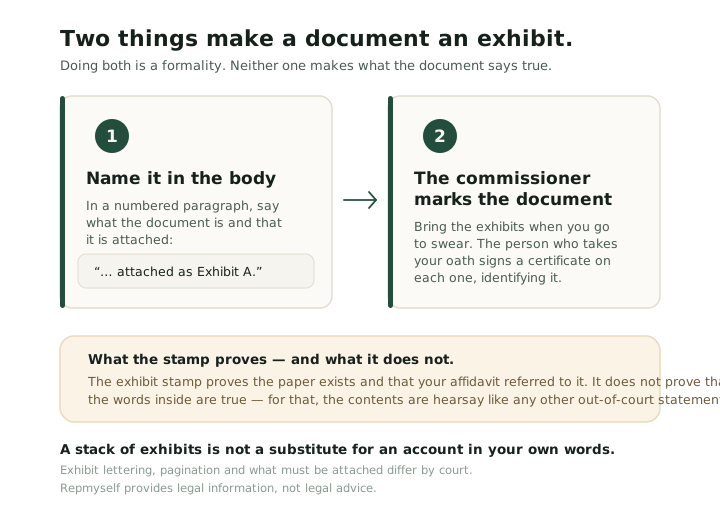
The person before whom the affidavit is sworn must identify each exhibit by signing a certificate placed on it. In the Supreme Court the certificate reads: "This is Exhibit …… referred to in the affidavit of …… sworn (or affirmed) before me on ……"
In the Supreme Court, a documentary exhibit of 10 pages or fewer must be attached to the affidavit and to every served copy. One that exceeds 10 pages need not be filed with the affidavit, but must be made available for the court's use and for the other party's prior inspection. Pages of documentary exhibits are numbered sequentially straight through — from the first page of the first exhibit to the last page of the last — even where an exhibit is not attached.
Whether the contents are admissible
Marking a document as an exhibit does not convert what is written inside it into evidence of its truth. A letter attached as Exhibit A proves that the letter exists and that you received it. It does not, without more, prove that the statements in the letter are true — for that purpose the contents are hearsay like any other out-of-court statement.
The practical consequence: a stack of exhibits is not a substitute for an account. If a document matters, say in the body of the affidavit what it is, how you came to have it, and what you personally know about it.
- Introduce every exhibit in the body. Describe what the document is and say it is attached — "The email is attached to this affidavit as Exhibit A."
- Letter them in the order they appear — A, B, C — following the order of the paragraphs that reference them.
- Bring the exhibits with you to be sworn. They are marked at the same time as the affidavit, by the same person.
- Do not summarise a document instead of attaching it. An exhibit speaks for itself; a paragraph describing what you think it shows is your opinion of it.
- Do not attach the whole file when a page will do — in the Provincial Court, every exhibit page counts against the 25-page limit below.
6Length, format and what you may not attach.
In the Provincial Court, affidavit length is not a matter of style. It is fixed by a practice direction of the Chief Judge, made under Rule 160 of the Provincial Court Family Rules, and it applies at every Provincial Court location in the province.
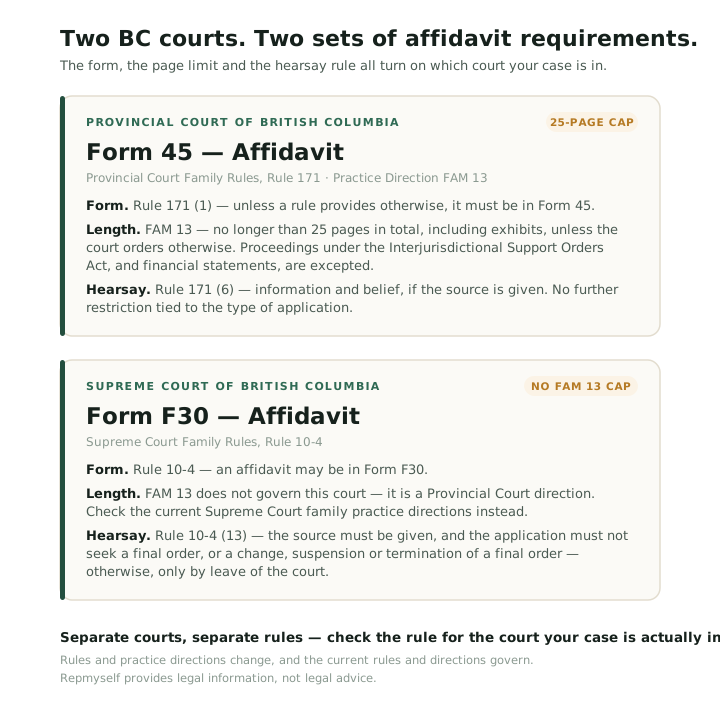
“Unless the court orders otherwise, an Affidavit (including Exhibits) in family proceedings must be no longer than 25 pages in total. (This does not apply to: (i) an Affidavit and Exhibits for proceedings under the Interjurisdictional Support Orders Act; or (ii) financial statements.)”
"Family proceedings" here means proceedings under the Family Law Act, the Child, Family and Community Service Act, the Family Maintenance Enforcement Act, the Interjurisdictional Support Orders Act and the Adult Guardianship Act.Twenty-five pages including exhibits is a real constraint, and it is the reason the discipline above matters. Every paragraph of opinion and every unnecessary exhibit page is spent from the same budget as the facts that actually decide the application.
Two further limits in the Provincial Court
“Affidavits and Exhibits in family proceedings must not include an intimate image of any person made by any means including a photograph, film, screenshot or video recording. Intimate image means an image in which a person in the image is nude, is exposing their genital organs, anal region or breasts or is engaged in explicit sexual activity. Instead, a written description of the intimate image may be included. A judge will determine whether to admit the image itself.”
Direction 4 adds that an intimate image already filed will, on application by a party or on the court's own motion, be sealed — and that the filing party may, with leave, file a replacement affidavit and exhibit without the offending material.“Unless the court orders otherwise, a document must not be provided on a USB stick or other electronic data storage device including a video or audio file.”
FAM 13 is made by the Chief Judge of the Provincial Court and applies to Provincial Court family proceedings. It does not govern the Supreme Court, which publishes its own practice directions separately. If your case is in the Supreme Court, check the current Supreme Court family practice directions rather than assuming the 25-page figure applies.
7Swearing it, changing it, and filing it unsworn.
Who takes it, and what they sign
An affidavit is made when you swear or affirm it, sign it (or place your mark on it if you are unable to sign), and the person before whom it is sworn completes and signs the required statement and marks each exhibit. In the Supreme Court, that statement takes this form:
“SWORN (OR AFFIRMED) BEFORE ME at …… [commissioner's city/town] ……, British Columbia on …….… [date] ……..… ………………………………… A commissioner for taking affidavits for British Columbia …. [print name or affix stamp of commissioner] ….”
The commissioner's name must be printed or stamped — a signature alone leaves no record of who took the oath.You may swear or affirm; both carry the same legal weight, and affirming is available to anyone who prefers not to swear an oath. Lawyers and notaries can commission affidavits in British Columbia by virtue of their office, and other people may be appointed commissioners for taking affidavits. Who may administer an oath is governed by the Evidence Act, R.S.B.C. 1996, c. 124.
- If you cannot read the affidavit, the person taking it must certify in the signed statement that it was read to you in their presence and that you appeared to understand it — Supreme Court Family Rules, Rule 10-4 (6).
- If you do not understand English, the affidavit must be interpreted to you by a competent interpreter, who must certify the interpretation on the affidavit by endorsement in Form F30 — Rule 10-4 (7).
- Swearing by video conference is permitted in the Supreme Court, but the affidavit must state in its last numbered paragraph that you were not physically present and appeared by video conference. It is then treated as sworn in the presence and at the location of the person taking it — Rule 10-4 (6.1).
- Alterations must be initialled by the person before whom the affidavit is sworn. Unless they are, the affidavit must not be used without leave of the court — Rule 10-4 (11). Do not change anything after swearing; print it again and swear the corrected version.
- An affidavit may be used even if it was made before the case was started — Rule 10-4 (15).
Filing before you have sworn it — Provincial Court only
The Provincial Court has a narrow allowance for the situation where a document has to be filed and there is no realistic opportunity to swear it first.
“An unsworn document may be filed even though the person who made the document has not sworn or affirmed to its contents if (a) the person has signed the document, and (b) it is not practicable for the person to swear or affirm to the contents of the document before the document is filed. … If an unsworn document is filed under subrule (2), the person who made the document must be available to swear or affirm that the contents of the document are true, as may be required by a judge or family justice manager, including at a subsequent court appearance.”
Rule 172 (1) defines "unsworn document" as a financial statement in Form 4, a guardianship affidavit in Form 5, an application about a protection order in Form 12 with an attached Schedule 1, or an affidavit in Form 45.8What happens when an affidavit breaks the rules.
The usual consequence is quieter, and worse, than most people expect: nothing visible happens, and the material simply does not count. Because Rule 10-4 (12) and Rule 171 (5) confine an affidavit to what could be given in evidence at a trial, anything outside that limit is not evidence the court can act on — whether or not the other party objects to it, and whether or not any formal ruling is made.
Beyond that, the court retains the ability to deal with the document itself. In the Supreme Court, Rule 10-4 (14) provides that an affidavit may be used in evidence despite an irregularity in its form only with leave of the court — so a defect is not automatically fatal, but it is also not automatically excused. In the Provincial Court, an affidavit that ignores the length, storage-device and intimate-image directions in FAM 13 is not in the form the court has directed, and the court may deal with it accordingly.
Courts routinely take steps to assist people without lawyers, and registry staff, Justice Access Centres and Family Justice Centres can help you understand what the forms require. But the rules of evidence are the same for everyone. An affidavit that is mostly opinion and argument will be given little or no weight regardless of who wrote it — which is exactly why the effort is better spent on the facts than on the case for why you should win.
There is a practical dimension too. Every paragraph of argument in an affidavit is a paragraph the other party has to read and answer, and a paragraph the judge has to work past to find the facts. In the Provincial Court it is also a paragraph consuming part of the 25 pages you are allowed. A shorter affidavit made entirely of dated, sourced, relevant facts is not a weaker document than a long one — it is a considerably stronger one.
Put your own paragraphs into the right shape.
Both builders lay out what you write. Neither drafts your evidence, decides what belongs in it, or checks whether it is admissible — that part is the work this page describes. Start with the court your case is actually in: the two courts use different documents, and an affidavit built for the wrong one is a document the registry should refuse.
Supreme Court affidavit
For a case in the BC Supreme Court — a notice of family claim, a chambers application, a judicial case conference. Collects what Rule 10-4 requires: your name, address and occupation, the affidavit number and registry, and the video-conference statement where it applies.
Build a Supreme Court affidavit → Provincial Court · Rule 171Form 45 affidavit
For a case in the BC Provincial Court, where Rule 171 (1) requires the court's own form. Puts your numbered paragraphs onto Form 45 itself, with the application-type box ticked and the jurat laid out to be sworn.
Build a Form 45 affidavit →Not sure which court? How a family case starts sets out what each court handles.
Questions people actually ask.
What can go in an affidavit in BC family court?
Only what you could say from the witness box at a trial. Rule 10-4 (12) of the Supreme Court Family Rules provides that, subject to subrule (13), an affidavit must state only what a person swearing or affirming the affidavit would be permitted to state in evidence at a trial. Rule 171 (5) of the Provincial Court Family Rules is to the same effect. In practice that means facts you personally saw, heard, did or said, and that are relevant to the application before the court.
Which form is the affidavit in BC family court?
In the Supreme Court, Rule 10-4 (2) (d) of the Supreme Court Family Rules provides that an affidavit may be in Form F30. In the Provincial Court, Rule 171 (1) of the Provincial Court Family Rules provides that unless a rule provides otherwise, an affidavit must be in Form 45 (Affidavit — General), published as PFA762.
Can I put in my affidavit what someone else told me?
Sometimes, and the two BC courts differ. In the Provincial Court, Rule 171 (6) allows an affidavit to contain statements as to the information and belief of the person swearing it if the source of the information and belief is given. In the Supreme Court, Rule 10-4 (13) allows it only if the source is given and the affidavit is made in respect of an application that does not seek a final order or a change in, or a suspension or termination of, a final order, or by leave of the court under Rule 10-3 (4) (e) or 14-7 (71) (a). In both courts a general opening paragraph is not enough on its own: the rule asks for the source of the particular information.
How long can an affidavit be in BC Provincial Court?
Practice Direction FAM 13 (Family Affidavits and Documents), effective May 6, 2026, directs that unless the court orders otherwise, an affidavit including exhibits in family proceedings must be no longer than 25 pages in total. It does not apply to affidavits and exhibits for proceedings under the Interjurisdictional Support Orders Act, or to financial statements. FAM 13 applies at all Provincial Court locations in the province.
Does attaching a document as an exhibit make it evidence?
Not by itself. Marking a document as an exhibit satisfies the formalities in Rule 10-4 (8) to (10) of the Supreme Court Family Rules or Rule 171 (4) of the Provincial Court Family Rules, but it is a separate question whether the contents of the document are admissible for the purpose you are using them for. The ordinary rules of evidence, including the rule against hearsay, still apply to what is inside the exhibit.
Can exhibits include photos or screenshots of intimate images?
No. Practice Direction FAM 13 directs that affidavits and exhibits in Provincial Court family proceedings must not include an intimate image of any person made by any means, including a photograph, film, screenshot or video recording. A written description may be included instead, and a judge will determine whether to admit the image itself. An intimate image already filed will, on application by a party or on the court's own motion, be sealed. FAM 13 also directs that, unless the court orders otherwise, a document must not be provided on a USB stick or other electronic data storage device.
What happens if my affidavit contains things it should not?
The offending material generally carries no weight. Rule 10-4 (12) of the Supreme Court Family Rules and Rule 171 (5) of the Provincial Court Family Rules limit an affidavit to what could be stated in evidence at a trial, so material outside that limit is not evidence the court can act on. Under Rule 10-4 (14) of the Supreme Court Family Rules an affidavit may, with leave of the court, still be used despite an irregularity in its form. Practice Direction FAM 13 sets separate limits in the Provincial Court on length, storage devices and intimate images.
Can I file an affidavit before it is sworn?
In the Provincial Court, in limited circumstances. Rule 172 of the Provincial Court Family Rules provides that an unsworn document — which includes an affidavit in Form 45, a financial statement in Form 4, a guardianship affidavit in Form 5, and an application about a protection order in Form 12 with an attached Schedule 1 — may be filed even though the person who made it has not sworn or affirmed to its contents, if the person has signed it and it is not practicable to swear or affirm before filing. The person must then be available to swear or affirm that the contents are true as may be required, including at a later court appearance.
Can an affidavit be sworn over video?
In the Supreme Court, yes, with a required statement. Rule 10-4 (6.1) of the Supreme Court Family Rules provides that if a person swears or affirms an affidavit before another person by video conference, the affidavit must state, in its last numbered paragraph, that the person swearing or affirming was not physically present but was before that person by video conference. The affidavit is then treated as sworn or affirmed in the presence, and at the location, of the person before whom it was sworn.
Do I have to number the pages and the exhibits?
In the Provincial Court, yes to both. Rule 171 (2) (c) and (d) of the Provincial Court Family Rules require an affidavit to be divided into paragraphs numbered consecutively and to have page numbers, and require the exhibits to have page numbers if the affidavit has any. In the Supreme Court, Rule 10-4 (10) requires each page of the documentary exhibits, other than on an affidavit of service, to be numbered sequentially beginning with the first page of the first exhibit and ending with the last page of the last exhibit — on the originals and on all served copies, and even where an exhibit is not attached.
Where this comes from.
- Supreme Court Family Rules, B.C. Reg. 169/2009 — Rule 10-4 (affidavits: form and content, identifying affidavits, making, statement to be signed, video conference, interpretation, exhibits, alterations, limitation on contents, information and belief, defective affidavits) — https://www.bclaws.gov.bc.ca/civix/document/id/complete/statreg/169_2009_02
- Provincial Court Family Rules, B.C. Reg. 120/2020 — Rule 160 (practice directions), Rule 171 (form of affidavits), Rule 172 (filing unsworn documents) — https://www.bclaws.gov.bc.ca/civix/document/id/complete/statreg/120_2020
- Provincial Court of British Columbia — Practice Direction FAM 13, Family Affidavits and Documents, effective May 6, 2026 — https://provincialcourt.bc.ca/system/files/FAM-13.pdf
- Province of British Columbia — Form 45, Affidavit — General (PFA762) and its guidebook — https://www2.gov.bc.ca/gov/content/justice/courthouse-services/documents-forms-records/court-forms/prov-family-forms
- Province of British Columbia — Supreme Court family forms (Form F30 Affidavit) — https://www2.gov.bc.ca/gov/content/justice/courthouse-services/documents-forms-records/court-forms/sup-family-forms
- Evidence Act, R.S.B.C. 1996, c. 124 — who may administer an oath, and the reception of affidavits — https://www.bclaws.gov.bc.ca/civix/document/id/complete/statreg/96124_01
This page provides general legal and procedural information for British Columbia. It describes what the Supreme Court Family Rules, the Provincial Court Family Rules and Practice Direction FAM 13 provide about the form and contents of an affidavit. It does not decide what facts are relevant in any particular case, what evidence a person should give, what to admit or deny, or what position anyone should take — and it is not legal advice. Rules, forms and practice directions are amended; always confirm the current requirements before filing. Rule text on this page was checked against B.C. Reg. 169/2009 and B.C. Reg. 120/2020 as published on BC Laws, and against Practice Direction FAM 13 effective May 6, 2026. Last source review: August 2026.