What Happens at a Family Management Conference in BC Provincial Court?
An early court appearance under Part 4 of the Provincial Court Family Rules — what it is, who attends, what the court can consider and order, and what happens if the case does not settle. Legal information only.
A Family Management Conference (FMC) is an early court appearance in a British Columbia Provincial Court family case under the Family Law Act. Under the Provincial Court Family Rules, it is an informal, time-limited process in which a judge or a family justice manager helps the parties identify issues, explores options to resolve them, and may make certain orders and directions — including interim orders, consent orders, case-management orders, and directions about the next step in the case.
An FMC is not a trial. It is also not only a meeting to pick a trial date. Rule 36 describes it as a procedural stage where the court can stabilize the case and move it forward. This page is legal information only — not legal advice. It does not tell you what to say, what order to ask for, or what strategy to use.
On this page
- At a glance
- What is a Family Management Conference?
- When does an FMC happen?
- Who attends?
- What happens when the conference starts?
- Is an FMC a trial?
- What information can the court consider?
- Can the court make orders?
- Can the whole case be resolved?
- If the case does not settle
- What happens after
- How parties usually attend
- FAQ
At a glance
| What it is | Family Management Conference under Part 4 of the Provincial Court Family Rules |
|---|---|
| Court | Provincial Court of British Columbia |
| Governing rules | Rules 35 to 58 (Part 4), plus linked scheduling and attendance rules |
| Who conducts it | A judge or a family justice manager (Rule 47) |
| Usual place in the case | After an Application About a Family Law Matter (Form 3) and, where filed, a Reply (Form 6) — subject to registry requirements |
| Default attendance (practice direction) | Remote audio or video unless a judge orders otherwise (FAM 11; Provincial Court guidance) |
| Must parties attend? | Yes, if an FMC is scheduled (Rule 43) |
What is a Family Management Conference?
Part 4 of the Provincial Court Family Rules applies in all registries (Rule 35).
Rule 36 sets out the purpose. In the words of the rule, the purpose of a family management conference is to provide an informal and time-limited process in which the judge or family justice manager:
- Identifyassists the parties to identify the issues to be resolved;
- Exploreexplores options to resolve the issues;
- Manageis able to make case-management orders and directions based on information provided by or on behalf of the parties to ensure that a file is ready to proceed to the next step;
- Interimis able to make interim orders under Rule 50 to address needs until the parties resolve their family law matters; and
- Otheris able to make certain other orders listed in Rule 36(1)(e), including where no reply is filed, where the parties consent, or in the absence of a party under Rules 54 or 55.
A judge at an FMC may also make any other orders or directions as appropriate, in addition to the case-management powers referred to in Rule 36(1)(c) (Rule 36(2)).
Official Provincial Court guidance describes an FMC as less formal than a trial, and states that the time available differs by location but is generally expected to take about 60 minutes. That timing expectation comes from court guidance, not from a fixed minute-count in the Rules.
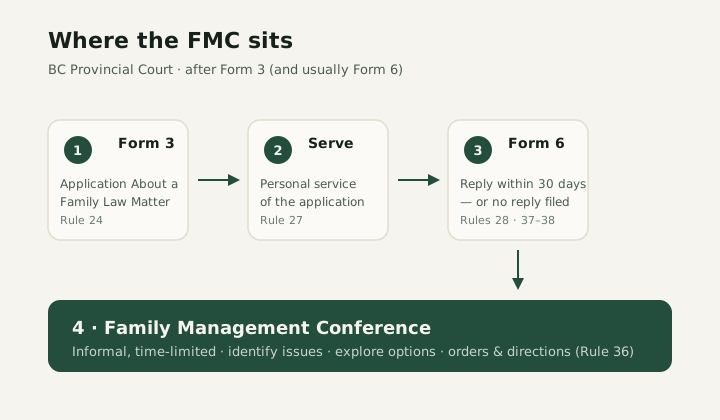
When does an FMC happen?
After Form 3 and Form 6 (or after service with no reply)
If an application about a family law matter and a reply have been filed, the registry must provide the parties with information about the procedure for scheduling an FMC, subject to parenting-education requirements where they apply (Rule 37).
If a party has filed an application, no reply has been filed, at least 30 days have passed since service based on the certificate of service, and any applicable early-resolution requirements have been met, the registry must provide that party with information about scheduling an FMC (Rule 38).
Parenting education program registries
In a parenting education program registry, the registry may not schedule an FMC unless at least one party has filed a certificate of completion of a parenting education program, or a notice of exemption in Form 20 (Rule 40; see also Rules 100 to 103).
Early resolution registries have their own pre-filing steps (Part 2). This page does not restate that entire track. For how a Provincial Court family case starts, including registry differences, see How a Provincial Court family case starts →
Other situations
The Rules also provide for an FMC in other defined situations, including preparing for certain hearings (Rule 41) and, after a long pause in the case, where a notice of intention to proceed is filed and the parties must participate in an FMC before continuing (Rule 42).
Who attends?
If an FMC is scheduled, all parties to the application about a family law matter must attend (Rule 43).
A lawyer for each party may attend with the party (Rule 44). Official Provincial Court guidance states that a lawyer may attend but is not required to.
An FMC may proceed without a party who does not file a reply, or who does not attend (Rule 45).
The conference may take place before a judge or a family justice manager, as applicable (Rule 47). Their powers are not identical. For example:
- Rule 52(2)a family justice manager may not make a final consent order about guardianship of a child at an FMC;
- Rule 54(1)a judge may make an order, including a final order, in the absence of a party;
- Rule 55(1)a family justice manager may make an order other than a final order in the absence of a party;
- Rule 57a family justice manager may not change, suspend or cancel an order made by a judge.
What happens when the conference starts?
The Rules do not script a minute-by-minute agenda. Rule 36 requires an informal, time-limited process focused on identifying issues, exploring options, and making permitted orders and directions.
Official Provincial Court guidance describes a common sequence in neutral terms: introductions and an explanation of how the conference will run; a short summary from each party of the problem that brings them to court (not a full trial of all evidence); questions to understand the issues; and discussion of options. That description is court guidance about practice, not a rule that every conference must follow the same script.
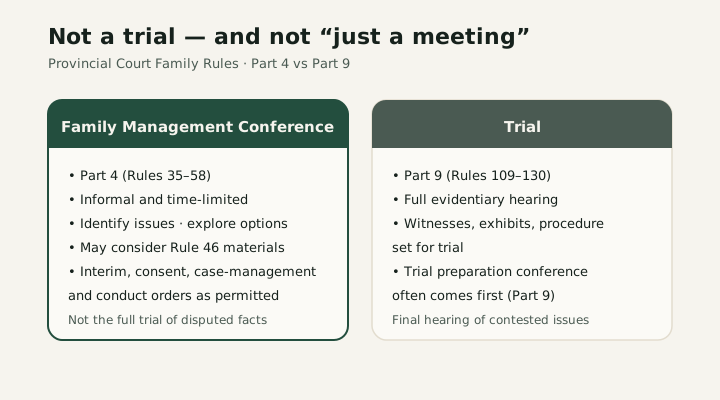
Is an FMC a trial?
No.
An FMC is not the final evidentiary trial of the case. Part 9 of the Rules deals with trials and trial preparation. An FMC is a separate stage under Part 4.
At the same time, an FMC is not “just a meeting.” Depending on the Rules and the issues before the court, evidence and submissions may be considered (Rule 46), and orders can be made (Rules 48 to 56).
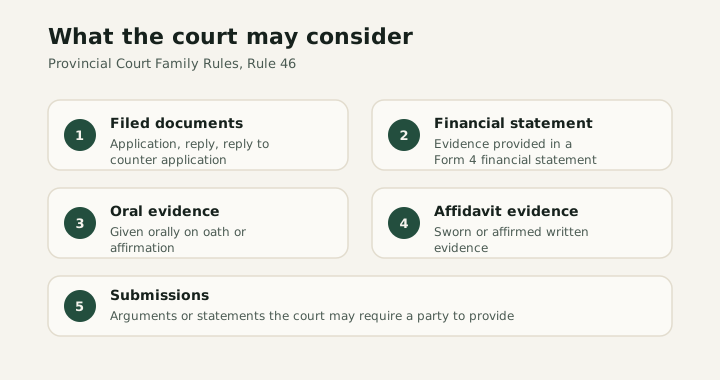
What information can the court consider?
Rule 46 provides that, for the purposes of an FMC, the judge or family justice manager may require a party to provide the following for consideration:
- Pleadingsinformation provided in an application about a family law matter, reply and reply to counter application, if any;
- Financesevidence provided in a financial statement;
- Oralevidence given orally on oath or affirmation;
- Affidavitaffidavit evidence;
- Submissionssubmissions.
Where support is in issue, a Financial Statement (Form 4) may already be on the file under Rule 25 or Rule 28. See Form 4 Financial Statement →
Can the court make orders at an FMC?
Yes. This is a central feature of Part 4.
Case management and readiness
A judge or family justice manager may make case-management orders under Rules 62 or 63, as applicable, to help get the file ready for the next step (Rule 48). They may also order a party to complete early-resolution or parenting-education requirements where those requirements apply (Rule 49).
Interim orders
A judge or family justice manager may make interim orders, including interim orders about parental responsibilities, parenting time, child support, contact with a child, guardianship of a child, spousal support, and property division in respect of a companion animal (Rule 50).
Rule 51 allows an interim guardianship order in defined circumstances before a Guardianship Affidavit (Form 5) is filed, with a default maximum term of 90 days unless renewed.
Consent orders
Subject to Rule 52(2), a judge or family justice manager may make orders with the parties’ consent, including final orders about the family law matters listed in Rule 52(1). A family justice manager may not make a final consent order about guardianship of a child.
Conduct orders
Subject to limits in Rule 53(2), a judge or family justice manager may make certain conduct orders under the Family Law Act provisions listed in Rule 53 (for example, requiring participation in family dispute resolution or counselling, or restricting communications between parties where a protection order would not be more appropriate).
Orders in the absence of a party
Rules 54 and 55 address orders made when a party is absent, and how an absent party may later apply to change, suspend or cancel such an order. The powers of a judge and a family justice manager differ, as noted above.
It describes the court’s authority under the Rules. It does not advise which order, if any, a person should seek, what to say at the conference, or what position to take.
Can the whole case be resolved at an FMC?
Sometimes.
If the parties agree, the court may be able to make a consent order, including in some cases a final order (Rule 52). Official Provincial Court guidance notes that if the parties agree on all issues, the court process for that application may end without a further appearance.
Even where the whole case is not resolved, an FMC can resolve some issues and set directions for the rest.
What happens if the case does not settle?
There is no single automatic path from FMC to trial.
Rule 56 provides that a judge or family justice manager at an FMC may order or direct that a party:
- CDRparticipate in consensual dispute resolution;
- Another FMCreturn for another family management conference;
- FSCattend a family settlement conference;
- TPCattend a trial preparation conference; or
- Hearingattend a hearing or trial.
Case-management and disclosure orders under Rules 48 and 62/63 may also shape what happens next.
A family settlement conference, if directed, is a separate process under Part 8 (Rules 104 to 108). It is conducted by a judge and is aimed at helping the parties try to resolve remaining issues by agreement.
If the direction is toward a hearing or trial, that is the start of trial readiness rather than the end of it. See setting a family trial: issues, witnesses and what to prepare.
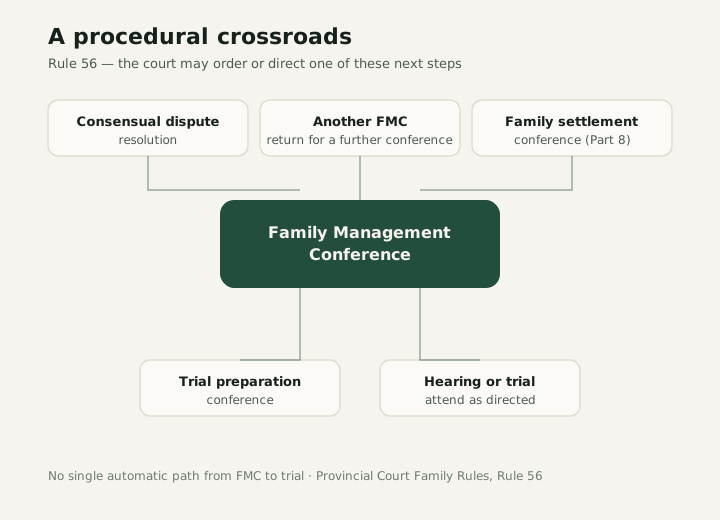
What happens after the FMC?
The result of an FMC is the set of orders and directions made at that conference — including any interim or consent orders and any direction about the next procedural step under Rule 56.
In that sense, the FMC is best understood as a procedural crossroads: the court organizes the case and determines how it should move forward, rather than merely booking a trial date.
How do parties usually attend?
Rule 163.1 of the Provincial Court Family Rules sets a default that court appearances are in person, and allows the Chief Judge to direct that a class of appearances may or must be attended by telephone, video conference or other electronic means.
Practice direction FAM 11 (effective May 6, 2026) directs that, for Family Law Act family management conferences, the default method of appearance is by audioconference or videoconference (including Microsoft Teams), unless a judge otherwise orders or directs.
Official Provincial Court guidance is to the same effect: FMCs are held by audio or video conference unless a judge orders otherwise, and in most cases parties do not need to go to the courthouse.
Always confirm the method of attendance on the notice or invitation for your own appearance. Practice directions can change.
Questions people actually ask.
Do I have to attend?
If an FMC is scheduled, Rule 43 requires all parties to the application to attend. Rule 45 provides that the conference may proceed without a party who does not attend (or who does not file a reply). Rules 54 and 55 address orders that may be made in a party’s absence.
Is the FMC in person or remote?
Under FAM 11 and Provincial Court guidance, the default for FMCs is remote audio or video, unless a judge orders otherwise. Check your notice for your appearance.
Do I need a lawyer?
The Rules allow a lawyer to attend with a party (Rule 44). They do not require a party to have a lawyer. Whether to obtain legal advice is a personal decision; this page does not recommend a particular choice.
How long does an FMC take?
The Rules describe the process as time-limited but do not fix a number of minutes. Provincial Court guidance generally expects about 60 minutes, depending on the location.
Can the judge (or family justice manager) make an order?
Yes, within the powers in Part 4 — including interim orders (Rule 50), consent orders (Rule 52), case-management orders (Rule 48), conduct orders (Rule 53), and certain orders in the absence of a party (Rules 54 and 55), subject to the limits described above.
Will I have to give evidence?
The court may require information and evidence of the kinds listed in Rule 46, which can include oral evidence on oath or affirmation, affidavit evidence, financial-statement evidence, and submissions. Whether any of that is required in a particular conference depends on the issues and the directions of the judge or family justice manager.
Will the court decide my whole case?
Not necessarily. An FMC can result in agreement and consent orders on some or all issues, or in interim and procedural orders while the case continues. A full trial, if needed, is governed by Part 9.
Does an FMC automatically lead to trial?
No. Rule 56 lists several possible next steps, including another FMC, consensual dispute resolution, a family settlement conference, a trial preparation conference, or a hearing or trial.
Official resources and sources
- Provincial Court Family Rules, B.C. Reg. 120/2020 — Part 4 (Rules 35–58), and Rules 37–42, 100–103, 104–108, 163.1 — https://www.bclaws.gov.bc.ca/civix/document/id/complete/statreg/120_2020
- Provincial Court of British Columbia — Family management conference guidance — provincialcourt.bc.ca … /family-management-conference
- Practice direction FAM 11 — Default Method of Attendance (effective May 6, 2026) — https://provincialcourt.bc.ca/system/files/FAM-11.pdf
Sources: Provincial Court Family Rules, B.C. Reg. 120/2020, Part 4 (Rules 35–58), and Rules 37–42, 100–103, 104–108, 163.1 — consolidation current to September 1, 2026 (BC Laws). Quoted and paraphrased statements of purpose and powers follow those rules. Provincial Court of British Columbia, “Family management conference” guidance page (practice description of typical conference length, formality, and remote attendance). Provincial Court practice direction FAM 11, Default Method of Attendance for Court Appearances under the Provincial Court Family Rules (effective May 6, 2026).
This page provides general legal and procedural information for British Columbia. It describes what the Provincial Court Family Rules and related court guidance provide. It does not advise what to say at a conference, what order to seek, or what position to take — and it is not legal advice. The Rules, practice directions, and court guidance change — always confirm against the current versions before relying on them for a filing or appearance. Last source review: September 6, 2026.