Setting a Family Trial in BC Provincial Court: Issues, Witnesses and What to Prepare
When a British Columbia Provincial Court family case is directed toward a hearing or trial, the useful work is not only getting a date. It is turning a broad dispute into an organized map: issues, the decisions the court may need to make, facts, evidence, documents, witnesses, and time.
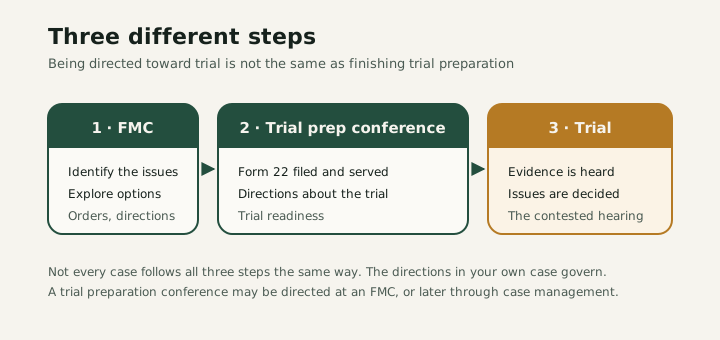
A Family Management Conference is a common procedural crossroads. Being directed toward trial there is not the same thing as completing trial preparation — that is governed separately by Part 9 of the Provincial Court Family Rules.
This page is legal information, not legal advice. It does not tell you which witnesses to call, what evidence to emphasize, what order to seek, or how to present your case.
At an FMC a judge or family justice manager may direct that a party attend a hearing or trial — one of five directions listed in Rule 56. That direction sets the path; it does not finish the preparation.
If a Trial Preparation Conference is scheduled, Rule 110 requires each party to file and serve a Trial Readiness Statement in Form 22 at least 7 days beforehand, unless the court orders otherwise.
On this page
- At a glance
- The Trial Map
- What “setting the case for trial” means at an FMC
- What issues are usually tried
- From a general complaint to a trial issue
- Witnesses: who has first-hand information?
- Organizing facts, documents and evidence
- Estimating trial time
- Setting a trial is not the end of trial preparation
- The Trial Map worksheet
- FAQ
At a glance
| What this page covers | Organizing issues, facts, evidence, documents, witnesses and time when a Provincial Court family case may go to trial |
|---|---|
| Court | Provincial Court of British Columbia |
| Key rules | Rule 56 (directions at an FMC); Part 9, especially Rule 110 (Form 22) and Rule 112 (trial preparation conference) |
| Usual earlier stage | Family Management Conference |
| Common later stages | Trial preparation conference; Provincial Court family trial |
| Core tool on this page | The Trial Map — issue → decision → facts → evidence → documents → witnesses → time |
The Trial Map
Build the case around one organizing chain, and repeat it for every issue that is still unresolved:
- Issue What is actually in dispute?
- Decision What order or decision does the court need to make about it?
- Facts Which facts relate to that decision?
- Evidence What could establish or challenge those facts?
- Documents Which records relate to the issue?
- Witnesses Who personally knows something about it?
- Time How much court time may this issue reasonably take?
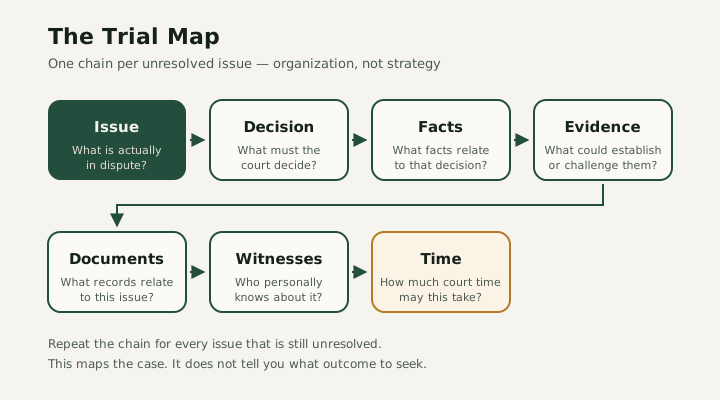
The educational goal is to break the case into the separate questions a judge may actually need to decide. This framework is for organization. It is not a strategy checklist for winning, and it does not rank your evidence for you.
What does “setting the case for trial” mean at an FMC?
An FMC is not itself the trial. It is also not simply a booking appointment.
Rule 36 describes a family management conference as an informal, time-limited process where the court helps identify issues, explores options to resolve them, and can make orders and directions so the file is ready for the next step.
Rule 56 lists the directions or orders to attend that may be made. They include consensual dispute resolution; another family management conference; a family settlement conference; a trial preparation conference; or a hearing or trial.
Confirm the current wording of Rule 56 on BC Laws before relying on it for an appearance.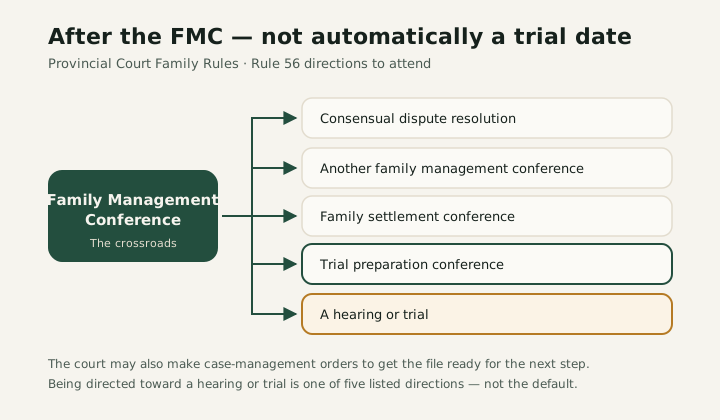
So when people say a case was “set for trial” after an FMC, what often happened is that the court directed the matter toward a hearing or trial path and may have made case-management orders to prepare the file. That is not the same as a completed trial preparation conference, and it is not the trial itself.
Practical questions that tend to arise
- Unresolved What issues remain in dispute?
- Agreed What issues are already settled between the parties?
- Orders Which orders are still being sought and opposed?
- Witnesses How many may be needed, and what does each personally know?
- Experts Are expert witnesses or a report under section 211 of the Family Law Act involved?
- Disclosure Is anything still outstanding?
- Applications Are there applications that need to be dealt with before trial?
- Time How much court time may reasonably be required?
Official Provincial Court guidance for Family Management Conferences tells parties to gather their facts, think about how they could prove them, collect relevant documents, reports and photographs, prepare a witness list with a brief summary of what each witness may say, and be ready for the possibility of trial preparation. That is court guidance about practice, not a rule — always confirm current guidance for your own appearance.
For the earlier stage, see what happens at a Family Management Conference.
What issues are usually tried in Provincial Court family cases?
“We are fighting about the kids” is not a useful description of a trial issue. Break broad disputes into identifiable decisions.
- Parenting time What parenting schedule or allocation of parenting time is disputed?
- Responsibilities Which parental responsibilities are disputed — education, health care, extracurricular activities, travel, passports, or others recognized under the Family Law Act?
- Guardianship Is guardianship itself in issue?
- Contact Is contact with a child by a non-guardian disputed, including its terms?
- Child support Is income, the table amount, retroactive support, or special and extraordinary expenses in dispute?
- Spousal support Is entitlement, amount, or duration disputed?
- Companion animals Is ownership or possession of a companion animal in issue?
Not every family dispute belongs in Provincial Court. Under Rules 4 and 5, these Rules apply to Family Law Act matters in Provincial Court with important exceptions. Ordinary property division (other than companion animals) and pension division are Supreme Court matters, and divorce is not a Provincial Court family-rules process. Do not assume every issue in a separation belongs in the same court file.
From a general complaint to a trial issue
Use structure, not advocacy.
“My ex is impossible and we cannot agree about the children.”
A more useful structure breaks the same complaint into its parts:
- Issue Parenting time
- Decision What parenting schedule should apply
- Facts The current schedule, the children’s ages, school routine, caregiving history, transportation realities, any relevant family-violence considerations, and other best-interests factors where applicable
- Evidence Party testimony, calendars, relevant communications, school or activity records, third-party evidence, reports
- Witnesses People with direct, relevant knowledge
The lesson is the structure: issue, then fact, then proof. This page does not tell you which facts or which evidence will persuade the court.
Witnesses: who actually has relevant first-hand information?
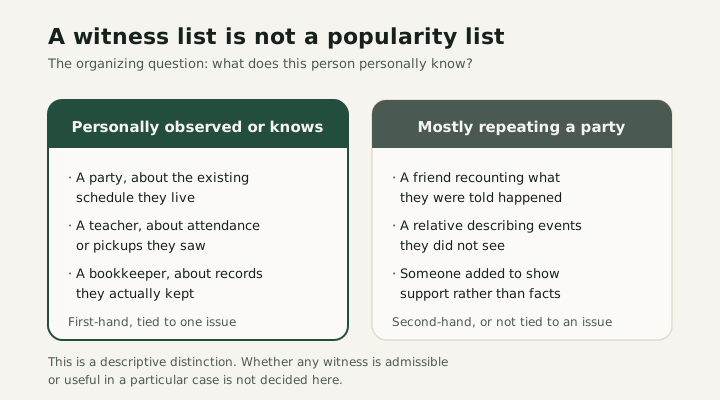
A witness list is not a popularity list. More witnesses do not automatically make a case stronger.
The organizing question is simple: what relevant information does this person personally know?
A witness worksheet
- Name / role Who is this person in relation to the case?
- Issue Which single issue does this witness relate to?
- Knowledge What did they personally observe or know?
- Relevance Why does that evidence relate to the decision the court must make?
- Time Approximately how long might their testimony take?
- Attendance Does attendance need to be arranged formally, including by subpoena under Rule 118 if a witness is required to attend?
Neutral examples
- Party A Parenting schedule — direct knowledge of the existing schedule and caregiving arrangements
- Teacher Parenting and routine — direct observations about attendance, pickup, or school-related matters
- Bookkeeper Support and income — direct knowledge of particular financial records or accounting information
There is a practical difference between a witness with direct knowledge and a person who would mainly repeat what one of the parties told them. This page states that distinction descriptively. It does not decide for your case who is admissible or persuasive.
Part 9 addresses the attendance of witnesses (Rule 118) and the consequences if a witness does not comply with a subpoena (Rule 119). Those are trial-process rules for a later stage; the point at this stage is simply to identify who may have relevant first-hand information.
Confirm the current text of Part 9 on BC Laws before relying on it.Organizing facts, documents and evidence by issue
Do not create one enormous chronology, or a folder of screenshots with no connection to the decisions the judge has to make.
For each unresolved issue, build a simple issue file that answers seven questions in order:
- 1 What is the issue?
- 2 What decision does the court need to make?
- 3 What facts relate to that decision?
- 4 What evidence could establish or challenge those facts?
- 5 What documents relate to the issue?
- 6 Which witnesses have direct evidence about it?
- 7 What remains disputed?
The emphasis is organization rather than advocacy. This page does not select evidence for you, rank evidence strategically, or draft your testimony.
Where financial issues are in dispute, a Form 4 Financial Statement may already be part of the file under the Rules that require financial disclosure.
Estimating trial time
The court often needs a realistic time estimate. That is difficult to give without understanding the shape of the case.
- Issues The number and complexity of unresolved issues
- Witnesses How many, and how long each may take
- Experts Expert evidence or a section 211 report, if any
- Documents The volume of records involved
- Evidence Time for each party’s evidence and for cross-examination
Provincial Court guidance for FMCs tells lawyers to identify the issues, identify consent matters, and provide a time estimate for a hearing or trial if the issues are not resolved. That is a neutral explanation of why trial length matters — not a formula.
There is no universal rule that one witness equals a set number of minutes. You can estimate the components on a worksheet, but actual trial length depends on the case and on the court’s directions.
Setting a trial is not the end of trial preparation
Getting a matter directed toward trial at an FMC is not the same thing as completing trial preparation. Part 9 of the Provincial Court Family Rules governs trials.
Rule 110 — Trial Readiness Statement (Form 22)
Each party must file and serve a trial readiness statement in Form 22 at least 7 days before the date of the trial preparation conference if one is scheduled, or as ordered by the court.
Confirm the current text of Rule 110 and the current Form 22 before filing.Rule 112 — what happens at a Trial Preparation Conference
At a trial preparation conference, Rule 112 allows the judge to make any order or give any direction the judge considers appropriate, including about:
- Timing The time required for the trial and the trial date
- Evidence The evidence to be required at trial, and affidavit evidence at trial
- Procedure The procedure to be followed at trial
- The child How the views of a child will be heard
- Experts Expert witnesses, including persons appointed to make assessments under section 211 of the Family Law Act
- Documents Filing and exchange of lists of documents; inspection or copying of records
- Applications Outstanding applications
- Agreed facts A statement of agreed facts
- Disclosure Disclosure of information, including financial information
- Witnesses Written summaries of proposed witness evidence
- Other Other directions to expedite the trial
Rule 112(2) also allows the judge to determine whether the trial will include alternative trial processes, including limits on time, types of evidence and number of witnesses — and, where family violence is an issue, alternative ways to examine and cross-examine parties. The judge may adjourn the trial if necessary (Rule 112(3)). Rule 113 provides that the judge who conducts the trial preparation conference is to conduct the trial, if possible.
A dedicated Trial Preparation Conference guide is planned. This page only tees that stage up, so that Trial Map work is not confused with finished trial preparation.
The Trial Map worksheet
Use one sheet — or one digital page — per unresolved issue, and repeat it for each one.
- Issue
- Decision What decision does the judge need to make?
- Agreed What is already agreed?
- Disputed What remains disputed?
- Facts Important facts connected to this issue
- Documents Documents or records connected to this issue
- Witnesses Witnesses with direct knowledge
- Experts Expert or section 211 evidence, if applicable
- Disclosure Outstanding disclosure
- Applications Preliminary applications still required
- Time Estimated time connected to this issue
This is the distinctive value of the exercise: a map of the case that does not tell you what outcome to seek.
Questions people actually ask.
Can a trial be set at a Family Management Conference?
A judge or family justice manager at an FMC may order or direct that a party attend a hearing or trial under Rule 56. The court may instead — or also — direct other next steps under Rule 56, such as a trial preparation conference or a family settlement conference. Do not assume that an FMC automatically locks in a final trial date, or that trial is the only possible next step.
Do I need to know all of my witnesses at the FMC?
You should be able to think carefully about who has direct, relevant knowledge and why. Official Provincial Court guidance for Family Management Conferences encourages a witness list with a brief summary of what each witness may say. Witness lists and evidence directions can continue to develop through later case-management orders and, if one is scheduled, a trial preparation conference under Rule 112.
What does the judge need to know before setting a family trial?
In practical terms: what remains unresolved, what is agreed, what evidence and witnesses may be involved, what disclosure or applications are still outstanding, and how much time may be needed. The exact information required depends on the orders and directions made in your own case.
How do I decide what the issues are for trial?
Turn broad complaints into specific decisions the court may need to make — for example a particular parenting-schedule question, a support calculation dispute, or a guardianship question — rather than one undifferentiated conflict narrative.
How many witnesses can I call?
There is no single number. At a trial preparation conference, Rule 112 allows the judge to give directions about evidence and witnesses, including limits as part of an alternative trial process. The organizing question remains relevance and direct knowledge, not volume.
Do I need a Trial Preparation Conference before trial?
Not every case follows the same path. A trial preparation conference may be directed under Rule 56 or through later case management. If one is scheduled, Rule 110 and Rules 111 and 112 apply.
What is a Trial Readiness Statement? What is Form 22?
Under Rule 110, each party must file and serve a trial readiness statement in Form 22 at least 7 days before a scheduled trial preparation conference, or as the court orders.
Can issues be settled after a trial date is set?
Yes. Rule 8 states that parties may come to an agreement or otherwise reach resolution about family law issues at any time. Settlement conferences and consent processes may still be available depending on the case.
What happens if I later need more trial time?
Trial time and the trial date can be addressed at a trial preparation conference under Rule 112. Adjournment of a trial date is addressed in Rule 114. Follow the orders and directions made in your case; this page does not advise whether to seek more time.
Official resources and sources
- Rules Provincial Court Family Rules, B.C. Reg. 120/2020 — especially Rules 4 and 5 (scope), 8, 36, 48 and 56, and Part 9 (notably Rules 110, 111, 112, 113, 114, 118 and 119)
- Court Provincial Court of British Columbia — Family management conference
- Court Provincial Court of British Columbia — 6 tips for lawyers on Family Management Conferences
Last source review: September 13, 2026. The Rules, practice directions and court guidance change — always confirm against the current versions before relying on them for a filing or an appearance.